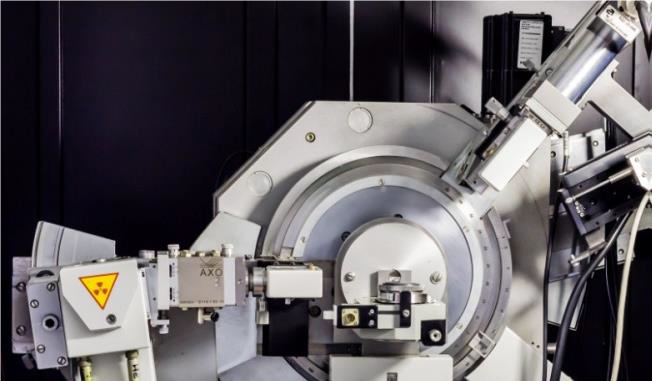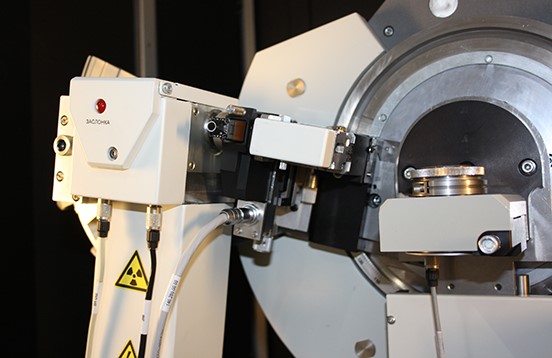
General-Purpose X-ray diffractometer 
DRON-8T

Request
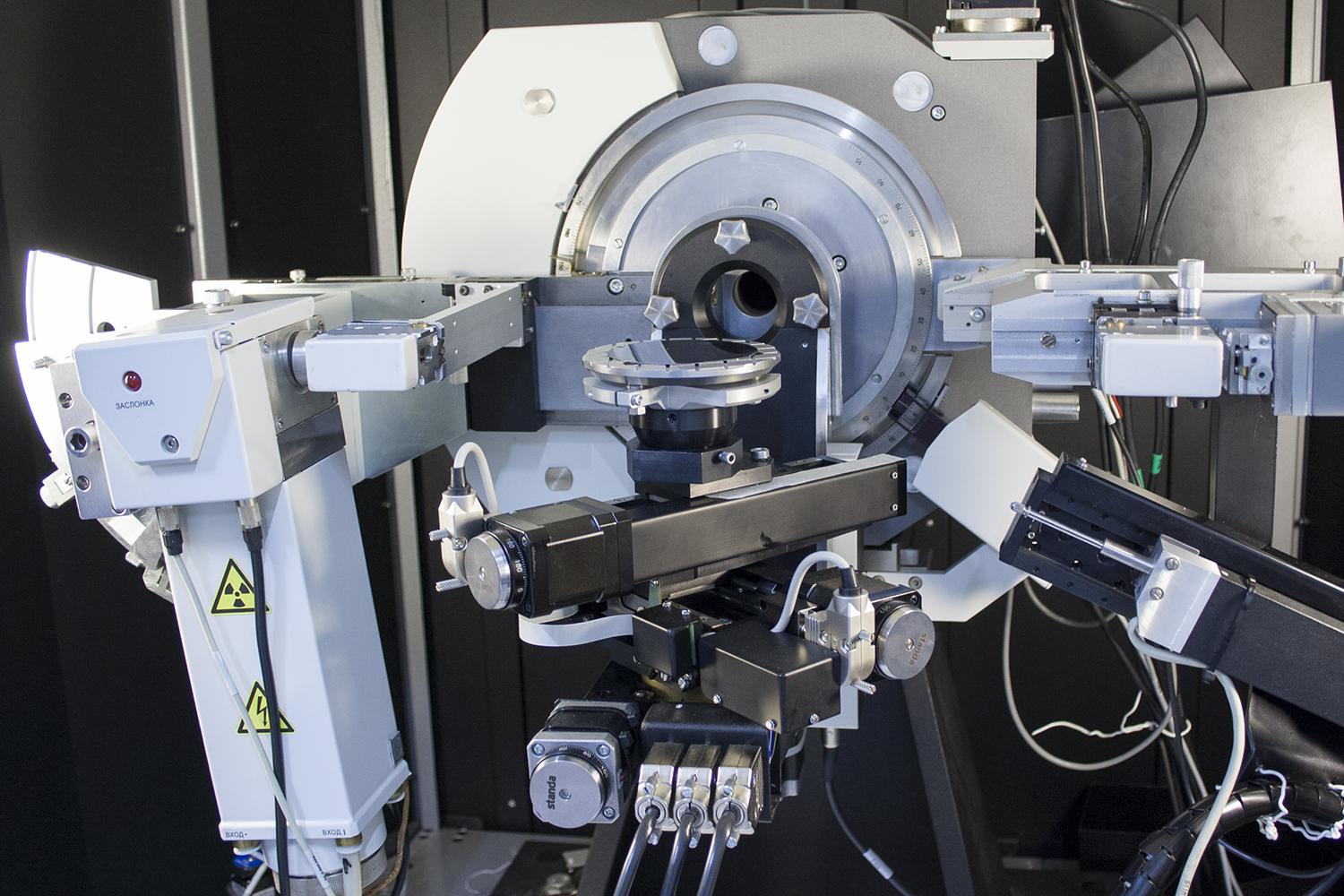
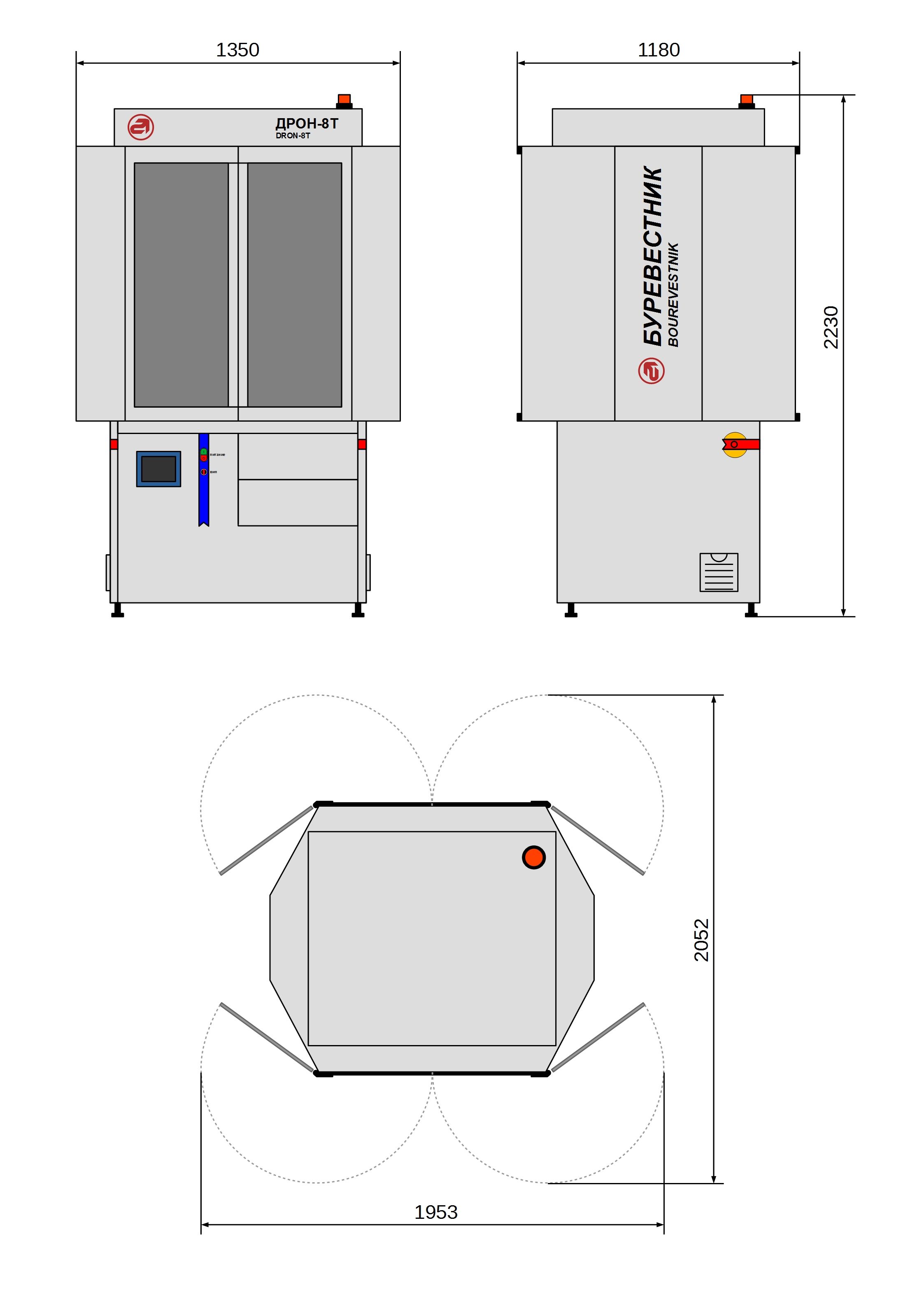
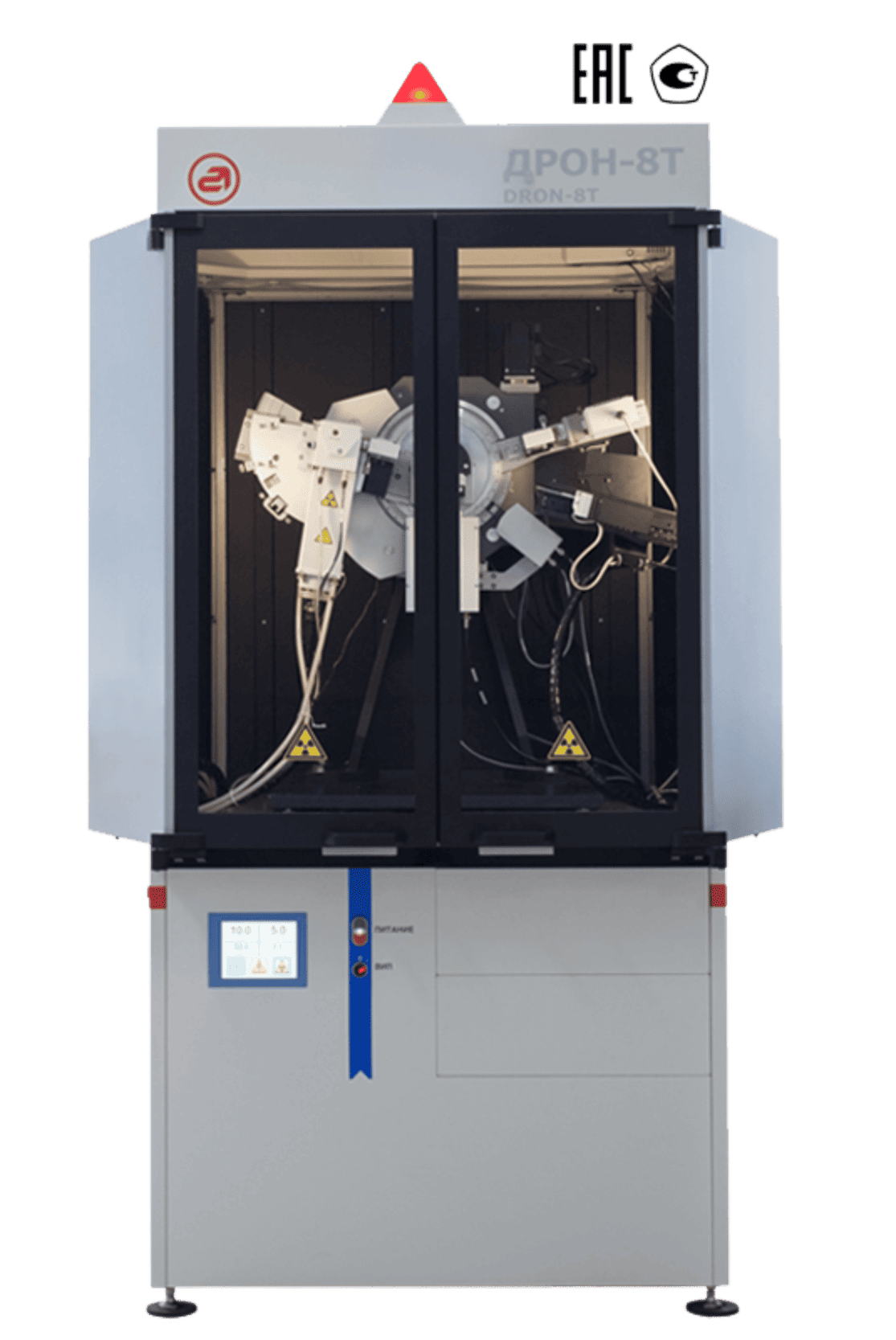
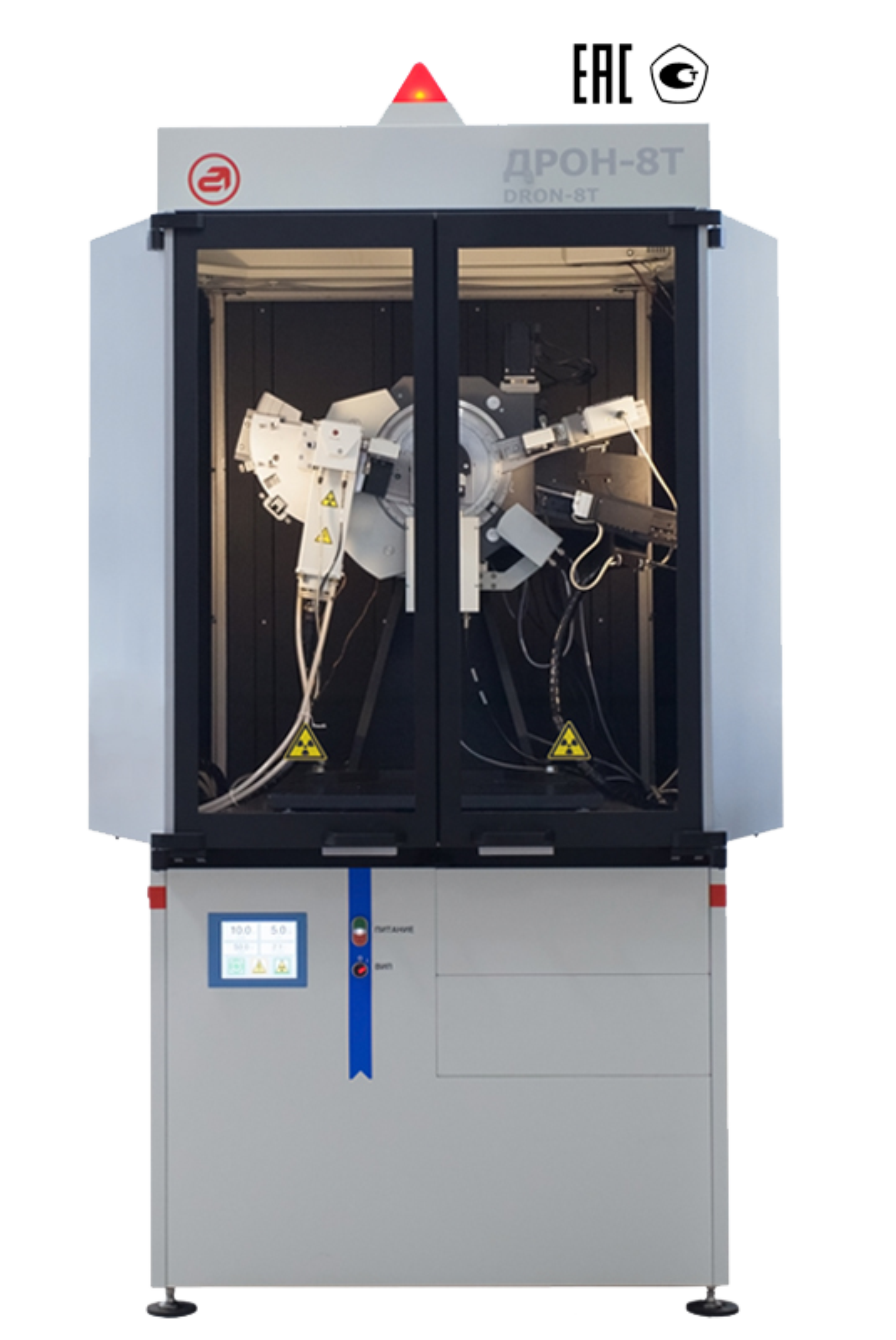
General-Purpose X-ray diffractometer DRON-8T

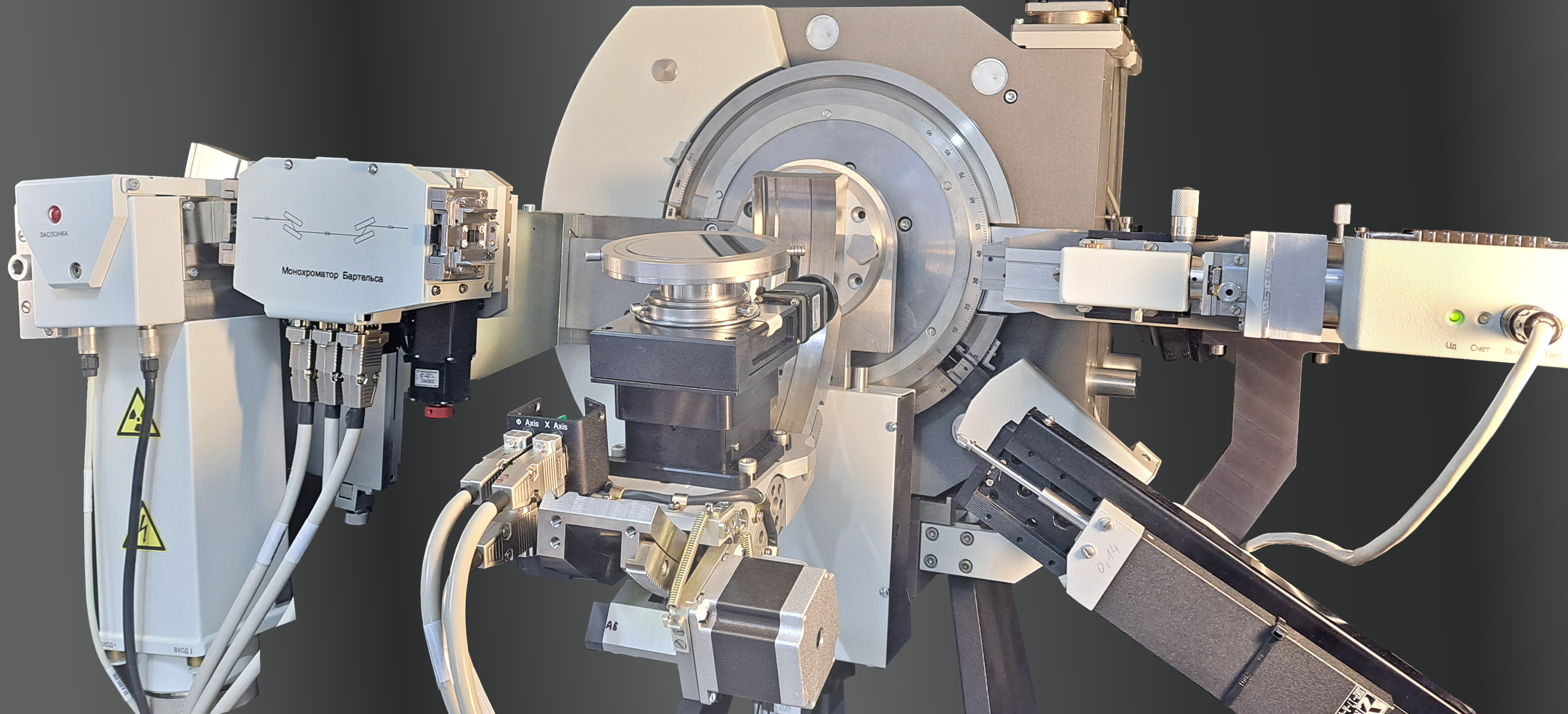
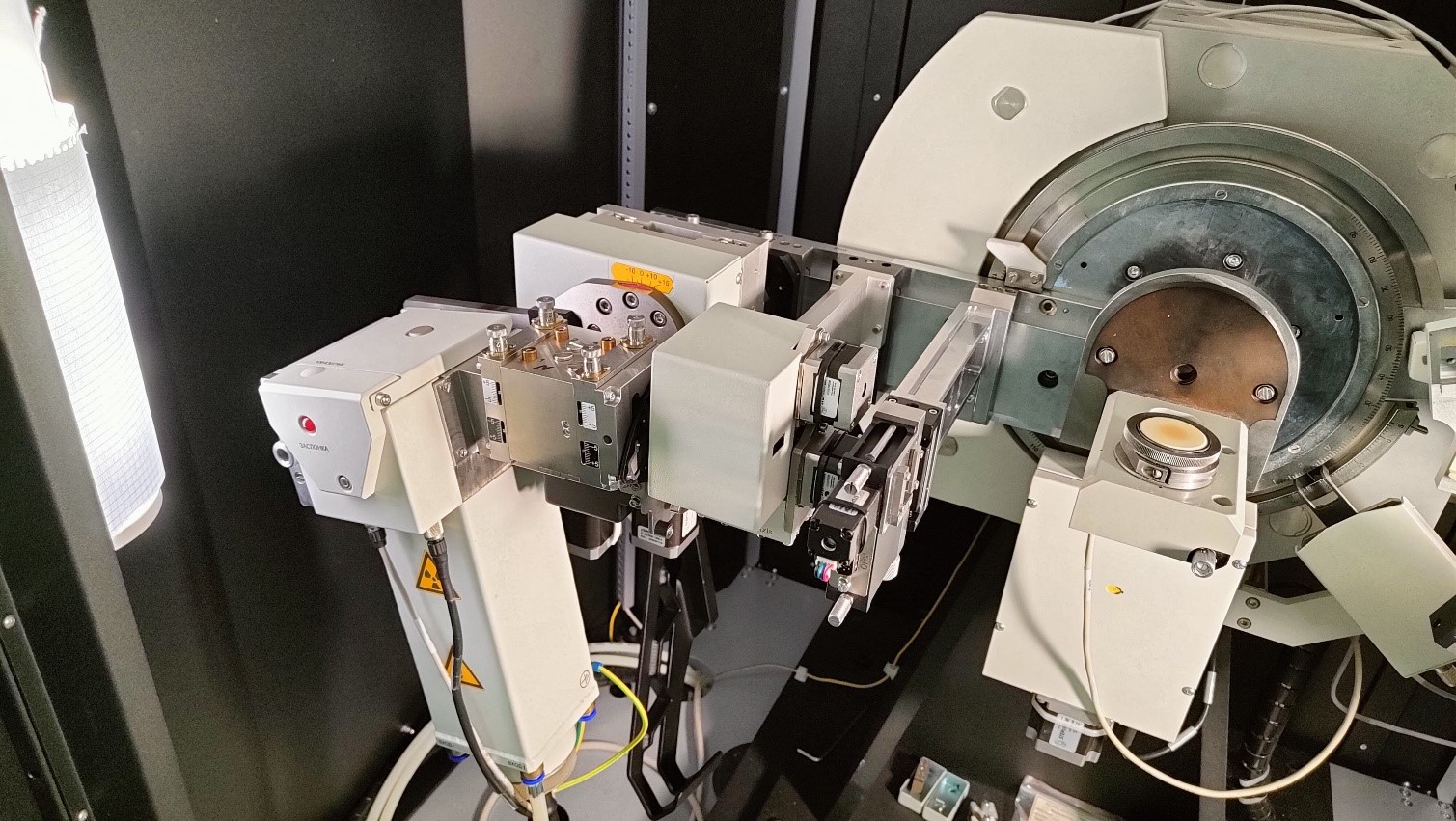
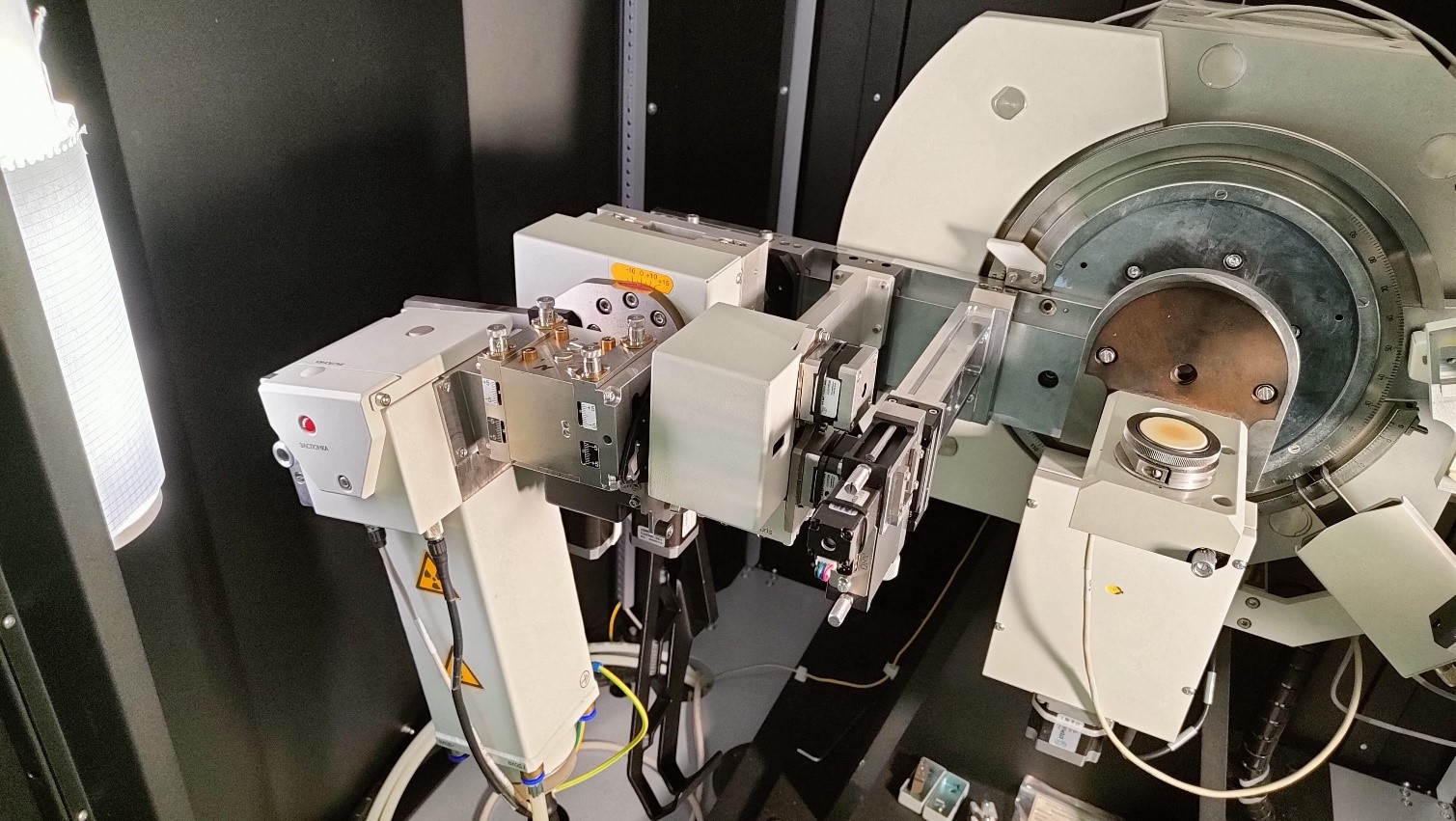
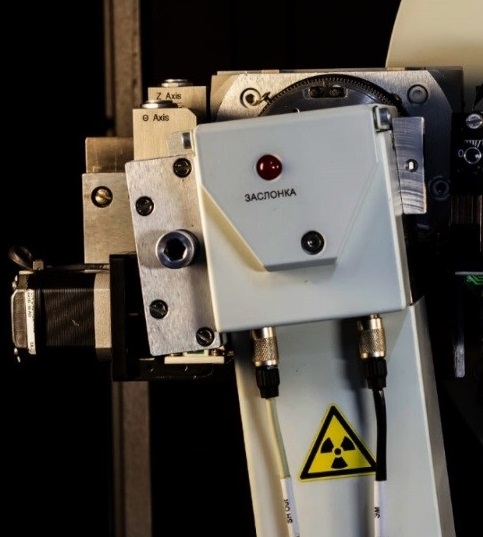
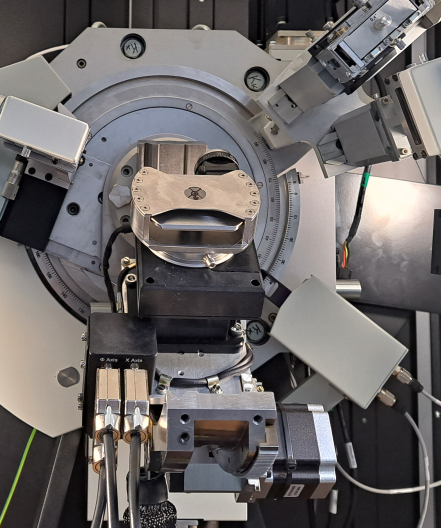
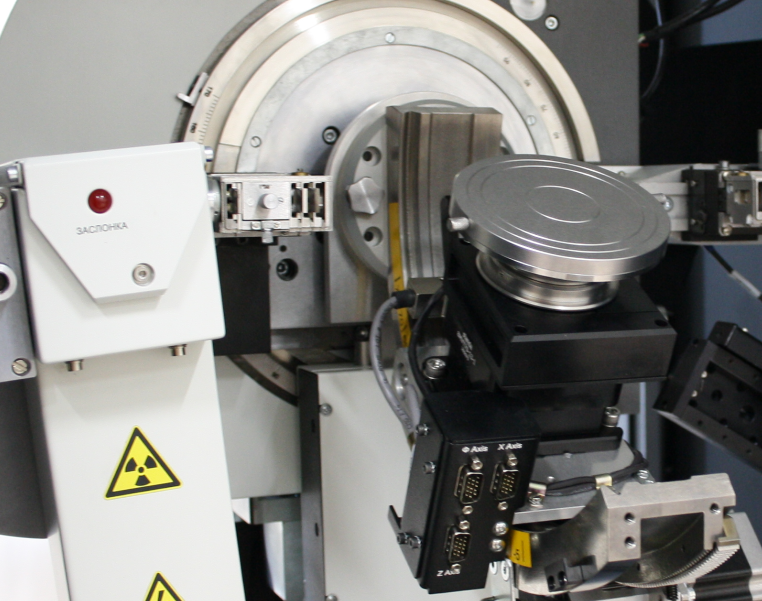
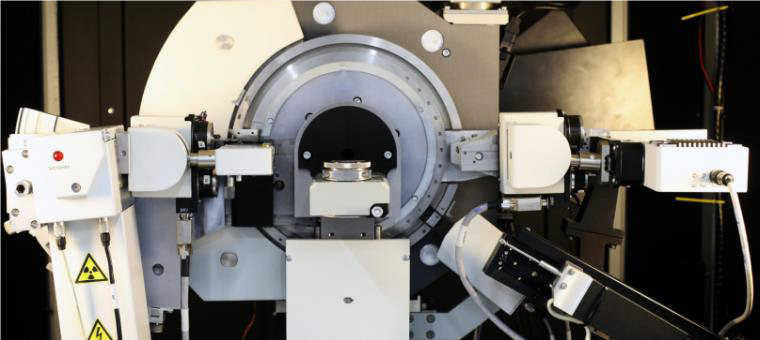
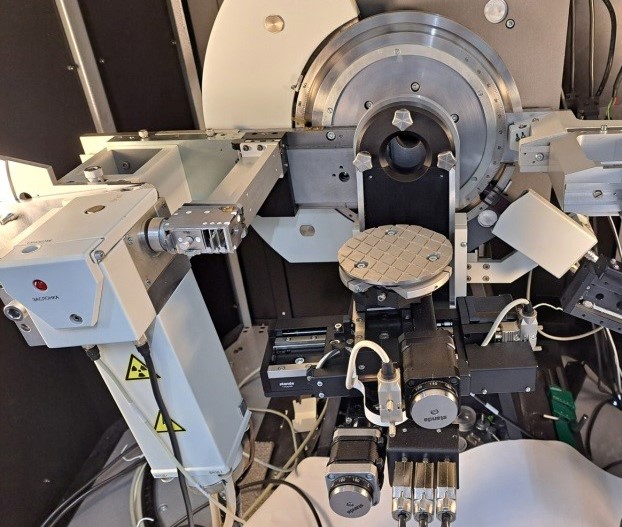
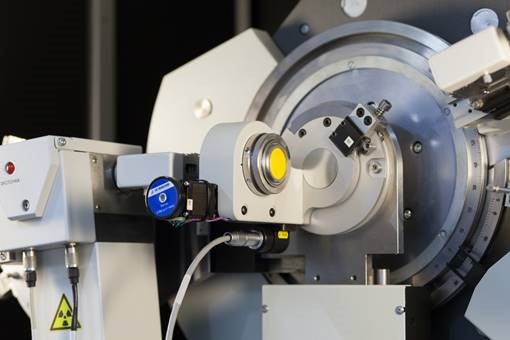
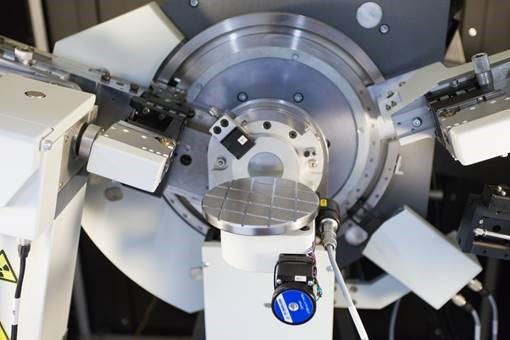
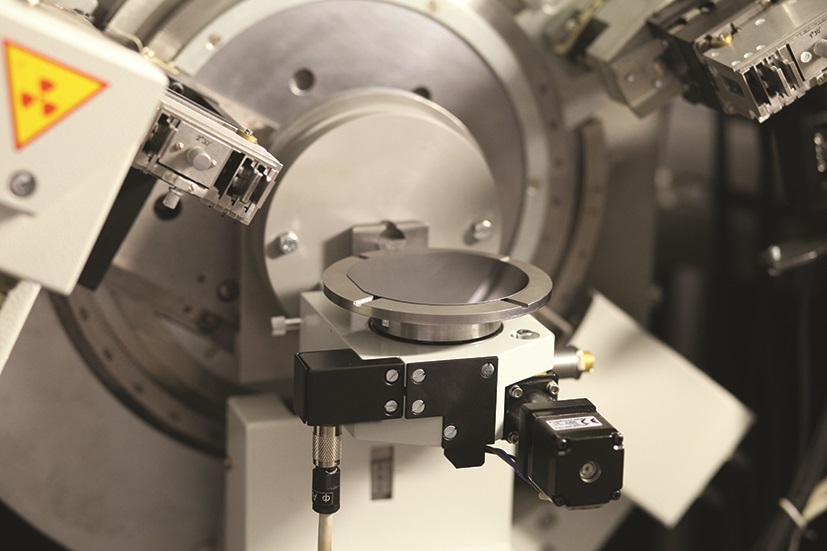
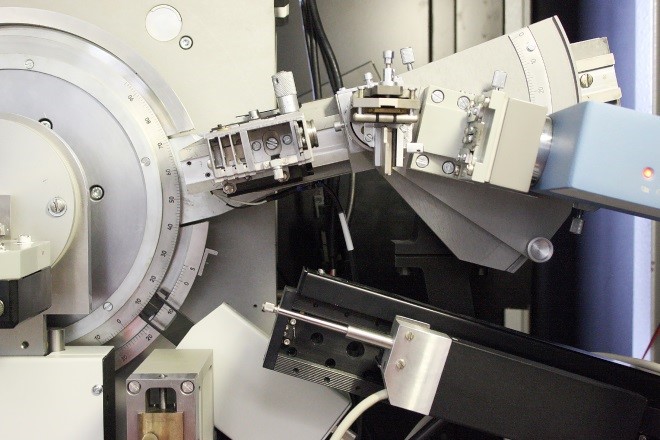
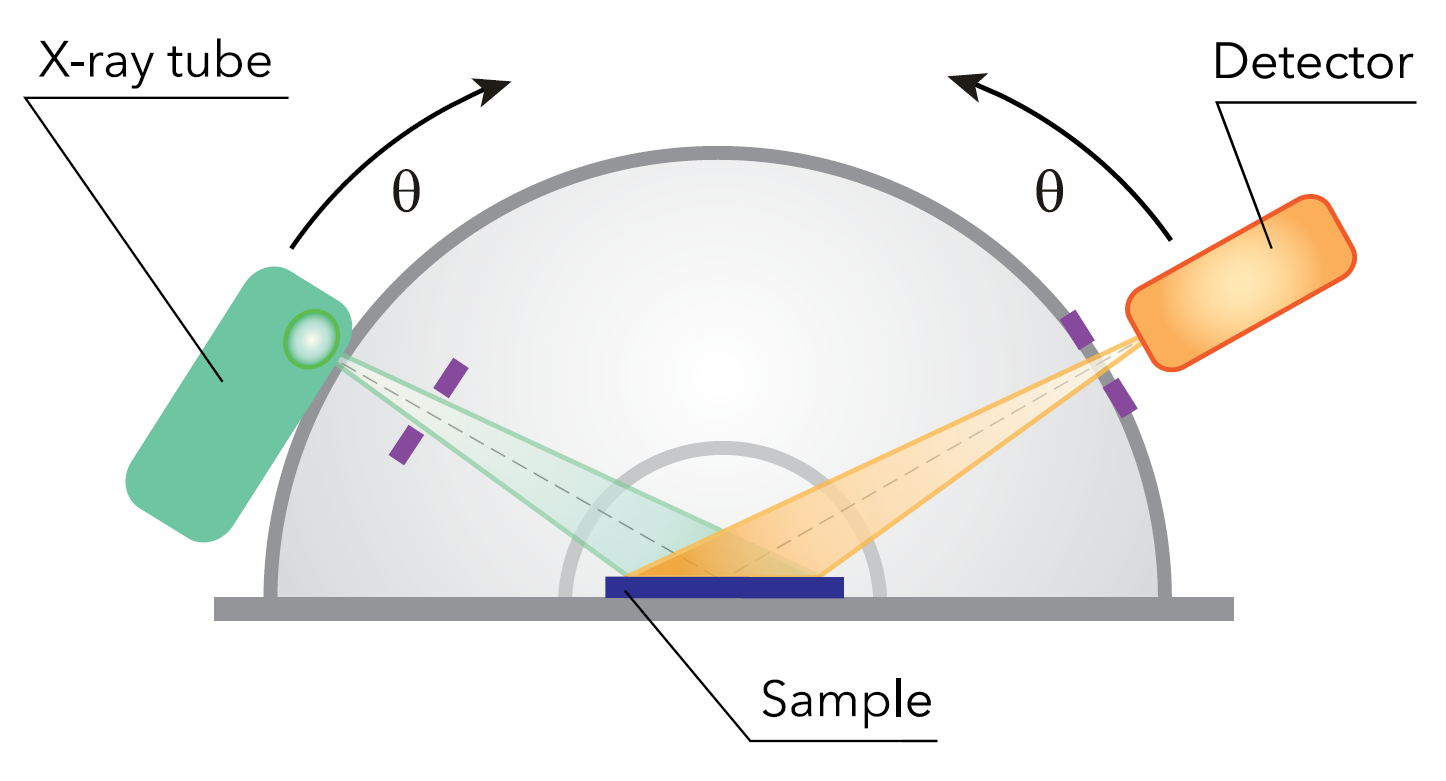
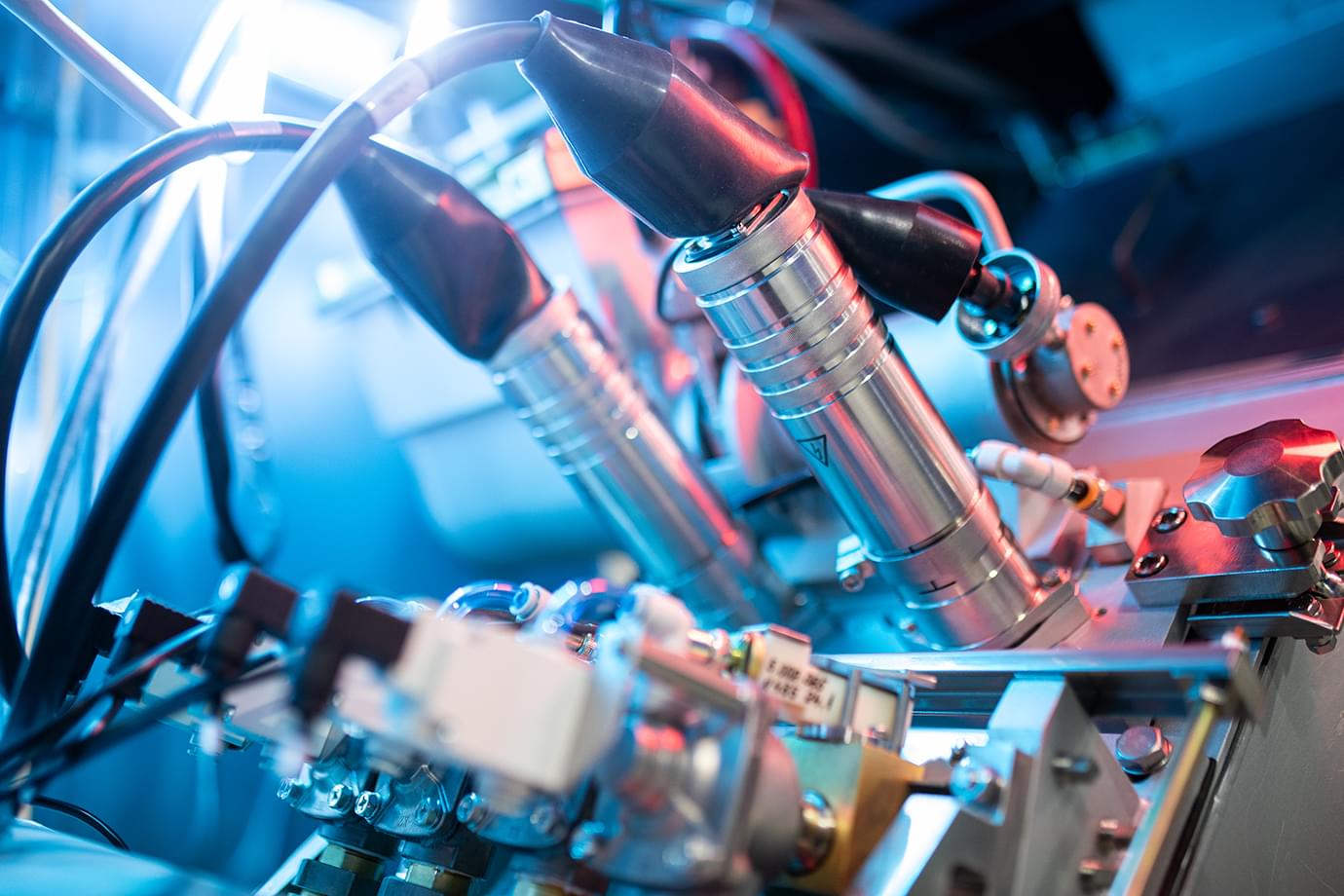
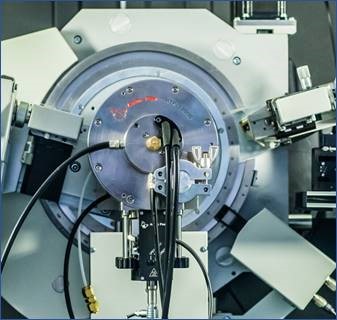
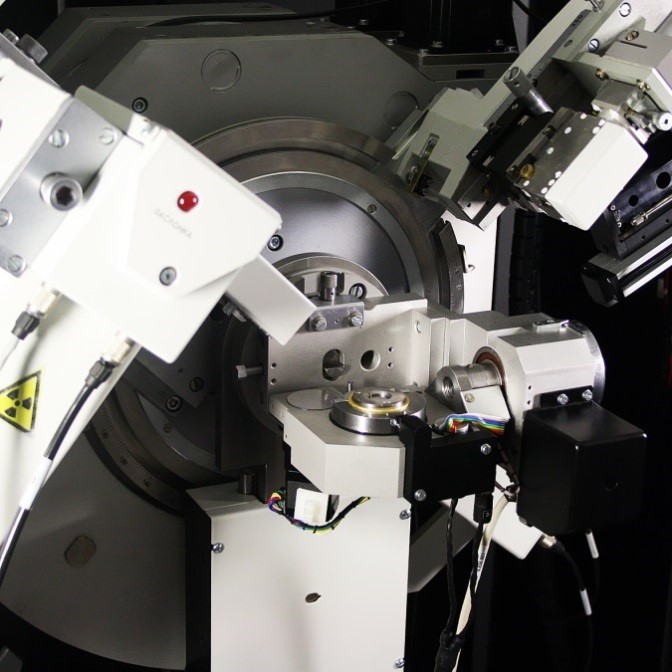
X-ray diffractometer DRON-8T is the flagship model of the line of stationary X-ray diffractometers of IC Bourevestnik JSC. It is equipped with a high-precision wide-angle vertical θ-θ goniometer with angular reproducibility of 0.0001° and is designed mainly for the study of highly refined crystalline objects (single crystals, epitaxial films) in high-resolution geometry.
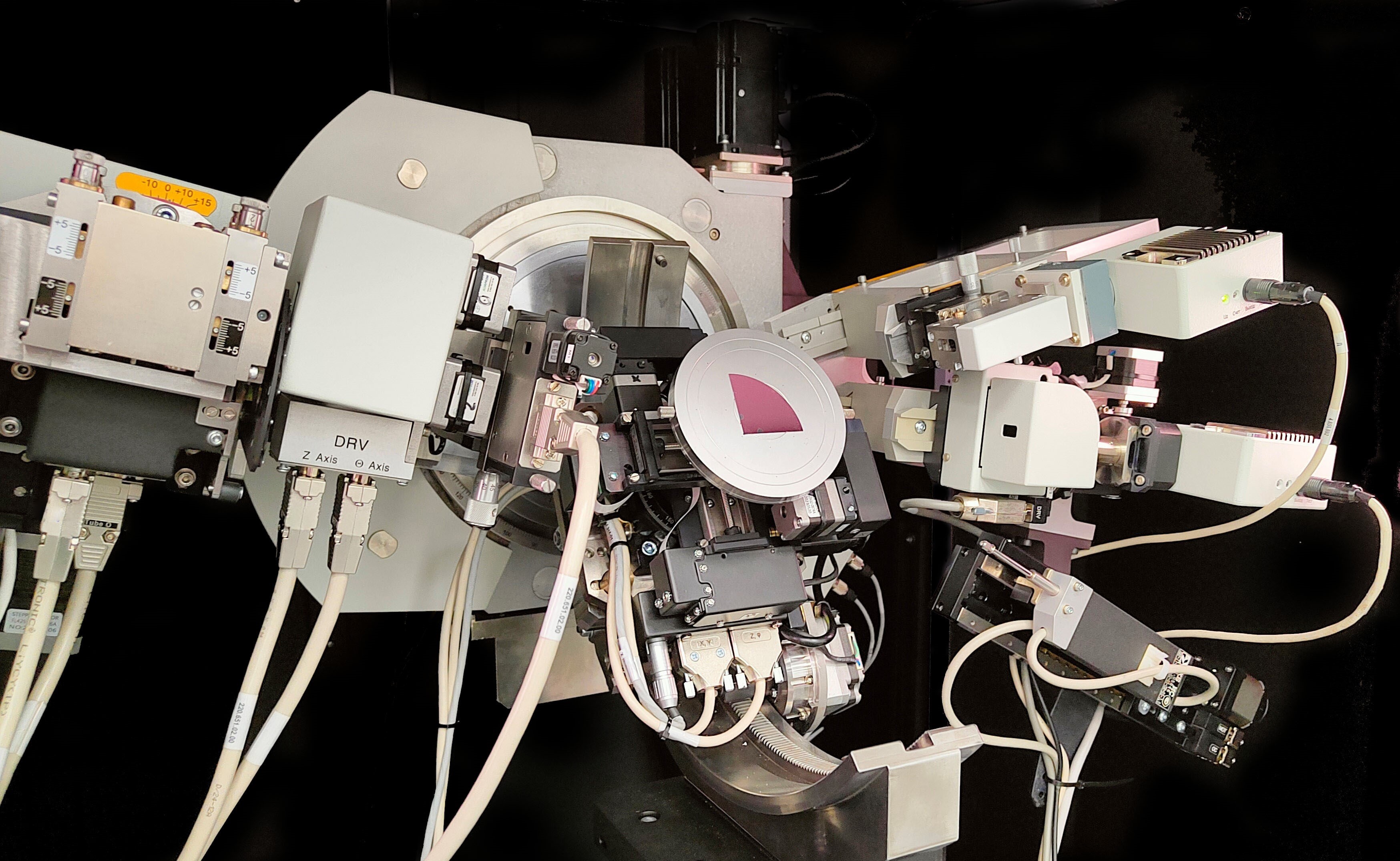
  • High-precision wide-angle vertical goniometer with changeable radius
  • Motorized tunable X-ray optical system (optional)
  • Realization of different measurement methods
  • Flexible machine configuration and a wide range of options
  • Variety of X-ray optical schemes
  • Software control of all devices and mechanisms
Specifications

GONIOMETER


Type
Vertical θ-θ
X-ray optics
Bragg-Brentano (basic)
Raduis R, mm
180-300
Angular range, deg.
from -10 to 165
θD from -5 to 165
θF from -5 to 95
Scanning modes
stepped/continuous
Scanning technique:
θ-θ, θ, Ω, 2θ-Ω
Min. scanning step, deg.
0.0001
Scanning rate, deg./min
from 0.1 to 100
Reproducibility, deg.
±0.0001
Travelling speed, deg/min
2000


RECORDING SYSTEM (BASE):


Detector type
Scintillation NaI (Tl)
Counting rate, imp/sec
up to 1000,000


HIGH-VOLTAGE POWER SOURCE:


Power supply, kW
3
Voltage, KV
0-60
Current, mA
0-80
Anode current and voltage stability, %
0,01
Cooling
air cooling


X-RAY TUBE (BASE):


Type
2,5BSV-27Cu
Focus, mm
0.4 х 8
Cooling
water cooling 

Controlling Personal Computer:

System unit: processor INTEL Core i5; RAM from 8 Gb; hard disk from 500 GB; OS Windows7/8/10 32 or 64 bit; availability of COM-port; availability of 2 Ethernet ports. Peripherals: LCD monitor from 24”. The above mentioned control computer is tested by the equipment manufacturer for compatibility with the diffractometer and is an integral part of it.

Basic equipment

  • Protective cabinet with interlock system of doors
  • Two-circle goniometer
  • High-voltage power supply for X-ray tube
  • X-ray tube BSV-29 in protective casing with program-controlled electromagnetic flap
  • Scintillation detection unit
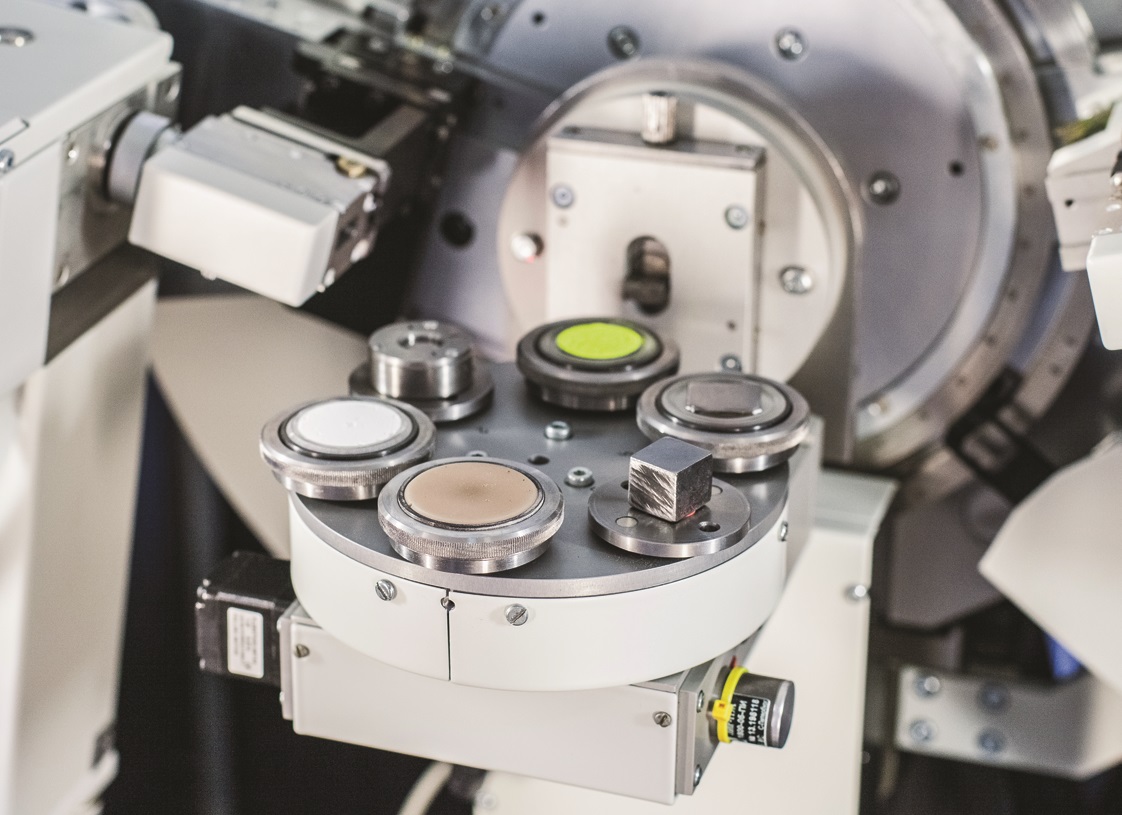
  • Rotating sample holder for powders
  • X-ray collimation system with a set of changeable slits
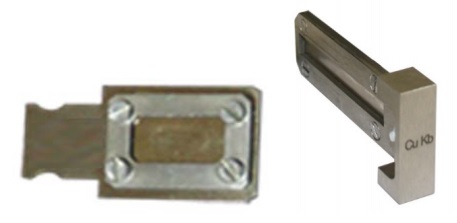
  • β-filter
  • Reference sample for device configuration
  • Data Collection software package for control and data collection
  • Personal computer
  • Set of spares tools, accessories and replacement parts

Options

Attachments and holders
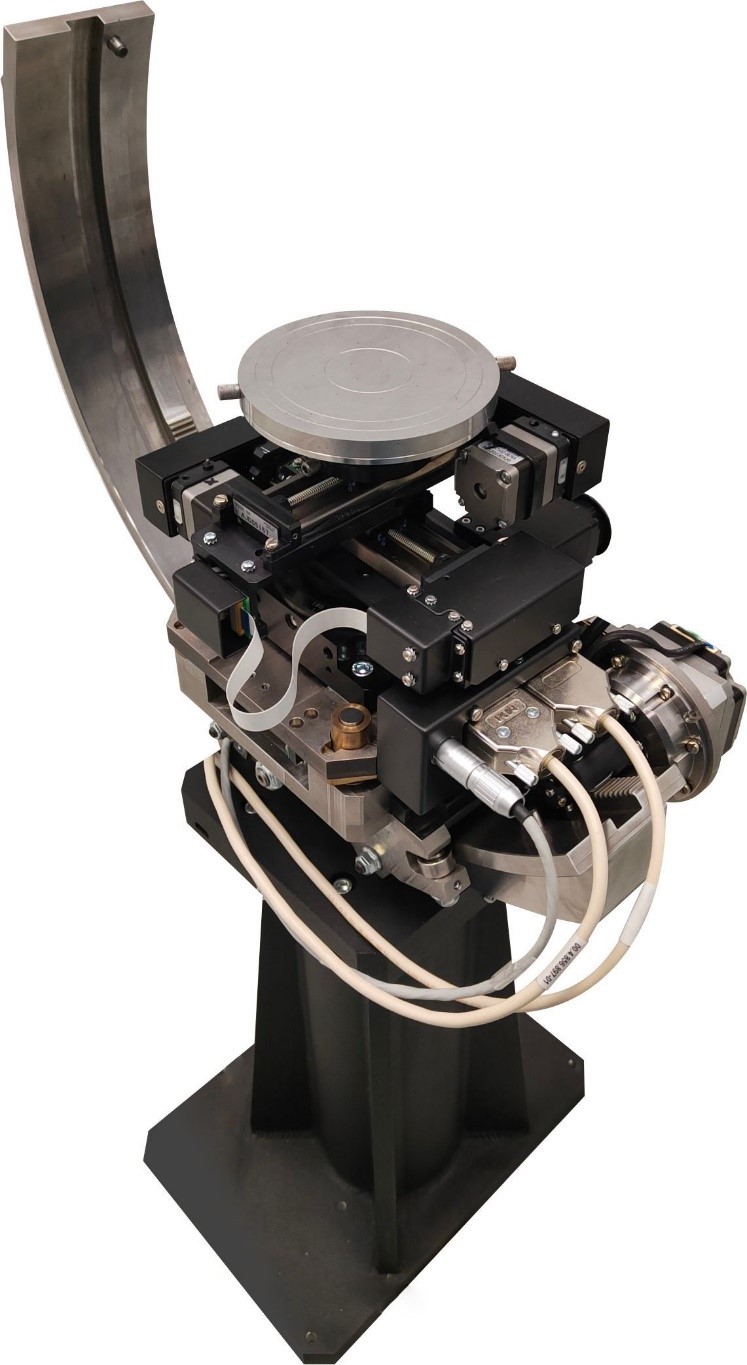
Multi-purpose five-axis xyzχφ attachment
Four-axis xyzφ holder for large samples
Three-axis φχz attachment with inclination
Three-axis xyφ attachment with carriages
Versatile stage for SAXS and XRR
Two-axis χφ PGTM attachment
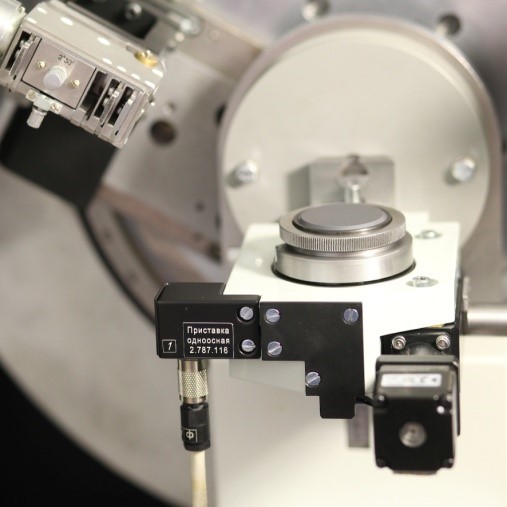
Single-axis φ-attachment
Gandolfi attachment
Autosampler
Cylindrical sample holder (capillaries)
X-ray optical elements
Tunable motorized x-ray optical system for high resolution geometry
Four-bounce Ge 220 x 4 channel-cut monochromator (Bartels type)
Universal motorized monochromator holders
X-ray optical system with parabolic mirror for parallel-beam geometry (Göbel Mirror)
Equatorial Soller slit with the divergence of 0.4°
Automatic attenuator for primary beam
Versatile monochromator holder for diffracted beam
Different types of crystals-monochromators
β-filters for monochromatization of various X-ray radiations
Ergonomics
Tunable motorized x-ray optical system for high resolution geometry
Automatic alignment system for the X-ray optical system
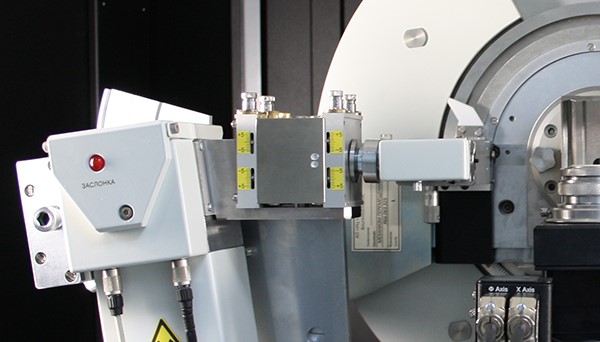
Motorized X-ray tube housing
Motorized equatorial slit on the primary beam
Motorized equatorial slit on the diffracted beam
Automatic attenuator for primary beam
Cooling system (chiller)
Laser beam indicator
Uninterruptible power supply kit
Video system
Cameras for research in special environments
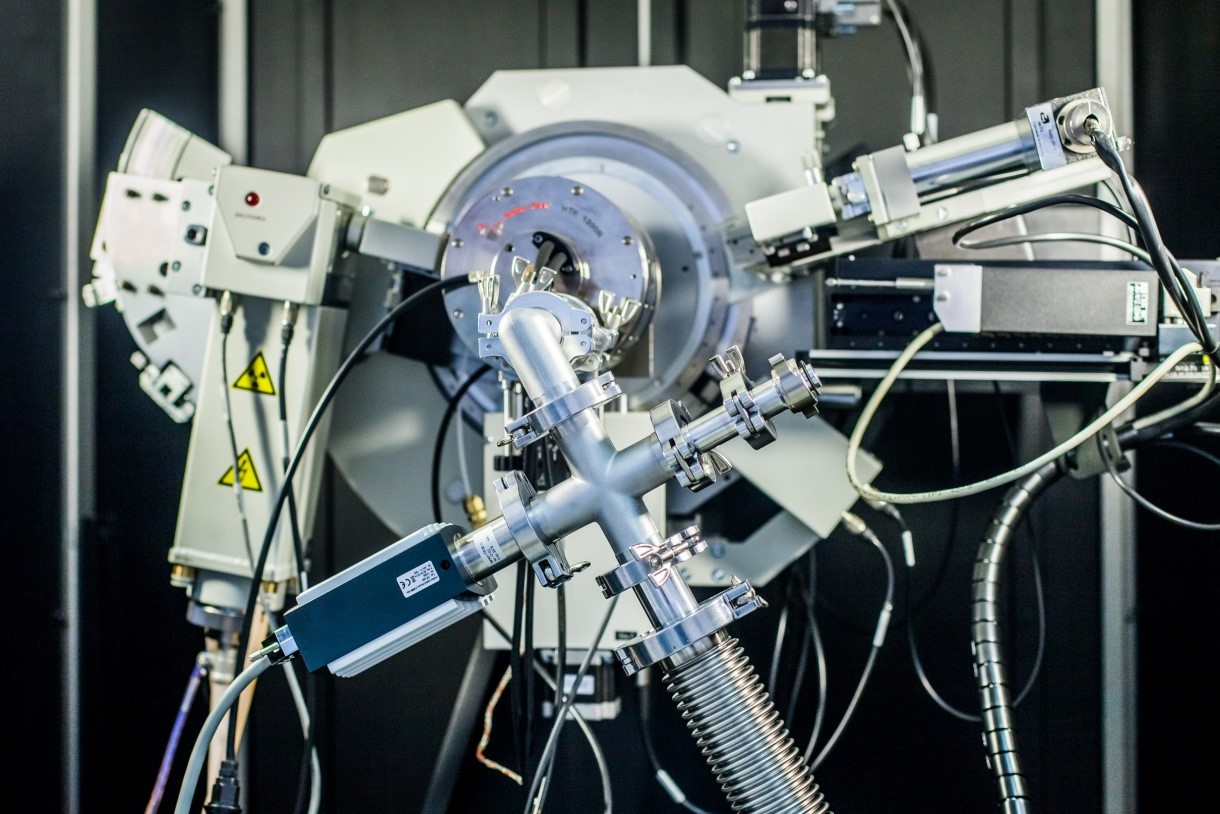
HTK-1200N High Temperature Chamber with Rotating Sample Holder
High temperature chamber HTK 16N/2000N with strip heater
Low temperature chamber TTK-600
Vacuum system
Registration systems
Fast registration system with Mythen 2 R 1D linear PSD
Kit for installation of two detectors
Cuvettes and sample holders
Calibration cuvette with a cup cut from silicon (111) single-crystal
Cuvette with variable depth for bulk samples
Low background cuvette with polished surface cut from silicon (911) single crystal
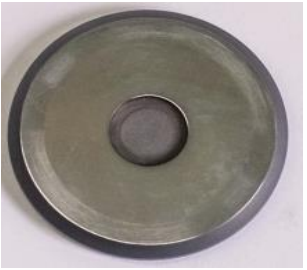
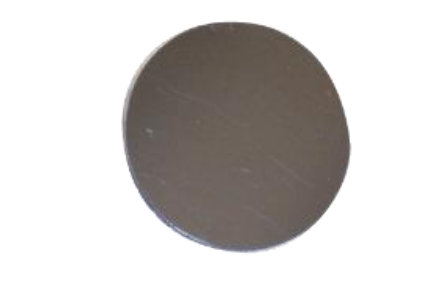
Low background polished wafer Ø25 * 1 mm cut from silicon (911) single crystal
Low background wafer Ø25 * 1 mm with a cup of Ø12 * 0.5 mm cut from silicon (911) single crystal
Low background wafer Ø25 * 1 mm with a cup of Ø20 * 0.5 mm cut from silicon (911) single crystal
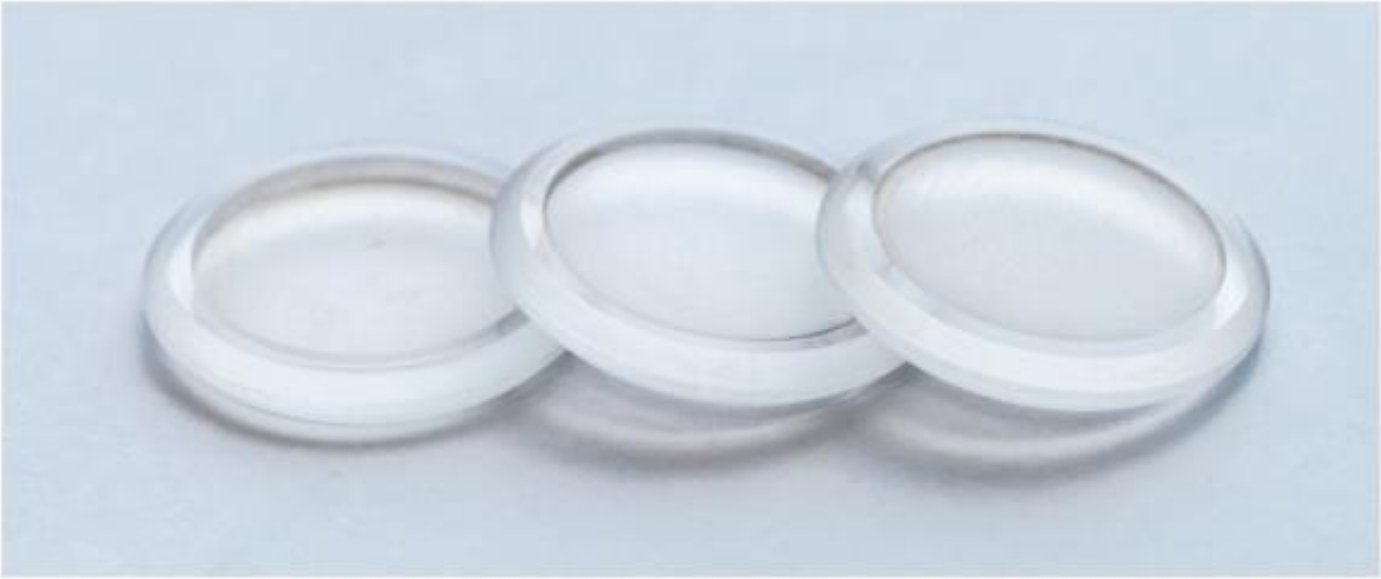
Quartz cuvettes of various depths
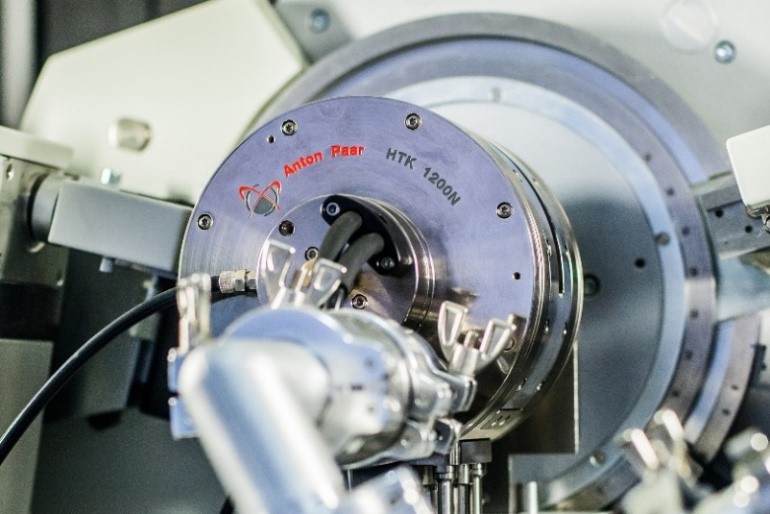
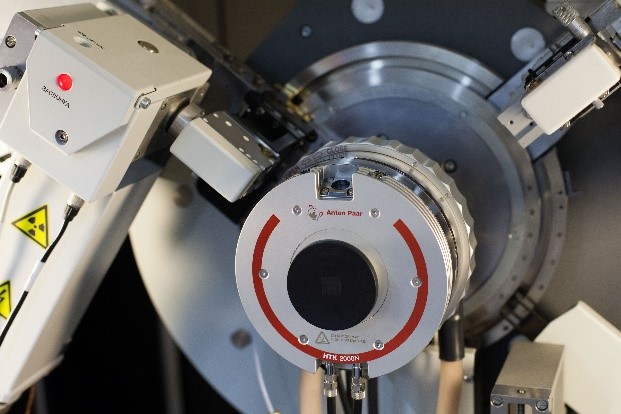
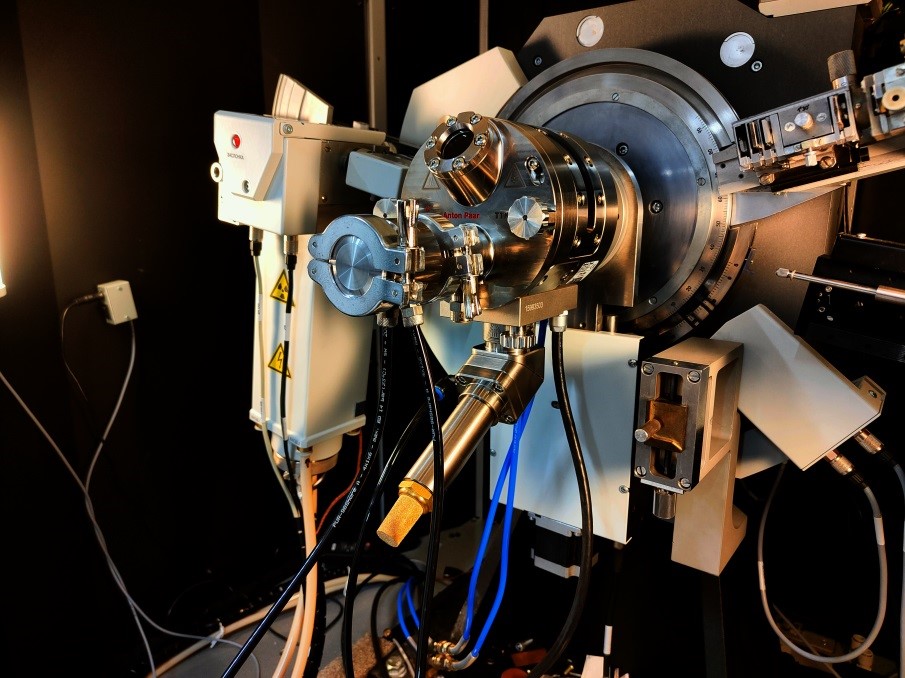
HTK-1200N High Temperature Chamber with Rotating Sample Holder

The HTK 1200N high-temperature chamber is used for in situ studies of phase transformations, chemical reactions and thermal deformations of the crystal lattice at heating from +25 to +1200 oC.

Pressure
10-4 mbar to 1 bar
Atmosphere
air, O2, N2, He, inert gases, vacuum (optional)
Scanning angles
0 - 164 ˚2θ
Cuvette
corundum, Ø 16 mm
Sample holder
Removable, with rotation

Mounted on the movement mechanism (elevator) to bring the sample plane to the goniometer axis.


нтк1.jpg

Without vacuum system

нтк2.jpg

With vacuum system

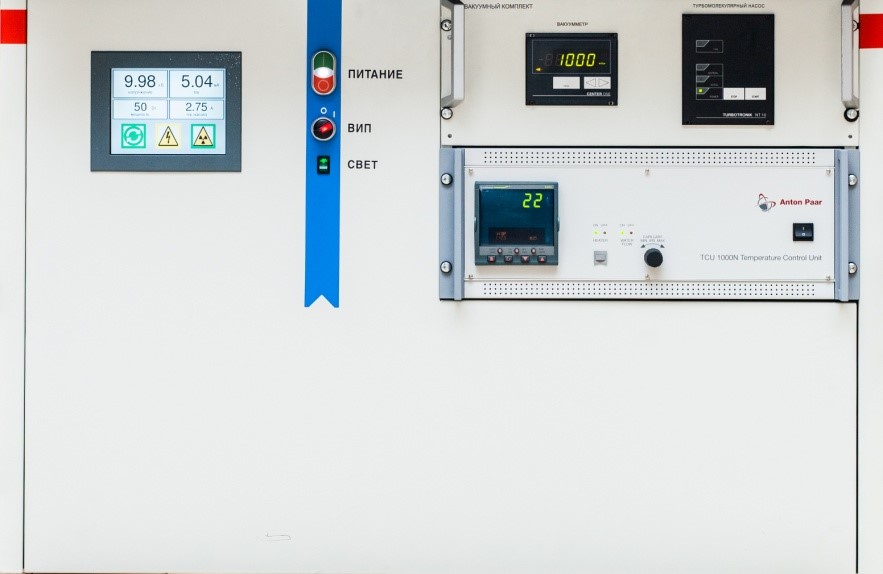
Система управления нагревом и вакуумом.jpg

Heating and vacuum control system

HTK-1200N High Temperature Chamber with Rotating Sample Holder

The HTK 1200N high-temperature chamber is used for in situ studies of phase transformations, chemical reactions and thermal deformations of the crystal lattice at heating from +25 to +1200 oC.

Pressure
10-4 mbar to 1 bar
Atmosphere
air, O2, N2, He, inert gases, vacuum (optional)
Scanning angles
0 - 164 ˚2θ
Cuvette
corundum, Ø 16 mm
Sample holder
Removable, with rotation

Mounted on the movement mechanism (elevator) to bring the sample plane to the goniometer axis.

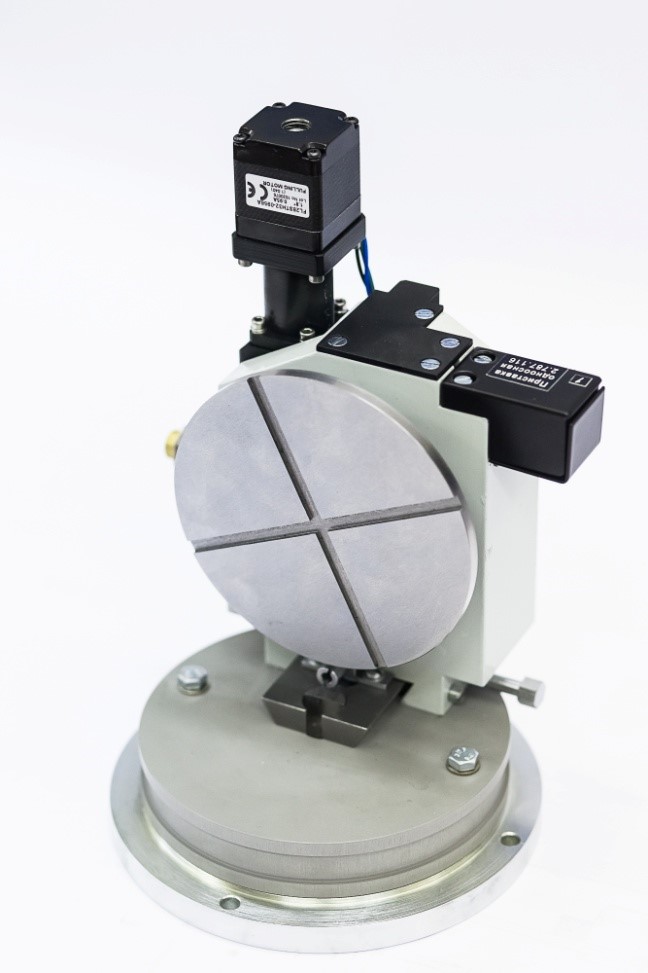
Multi-purpose five-axis xyzχφ attachment

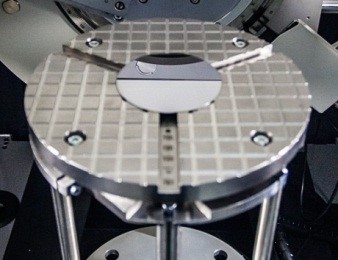
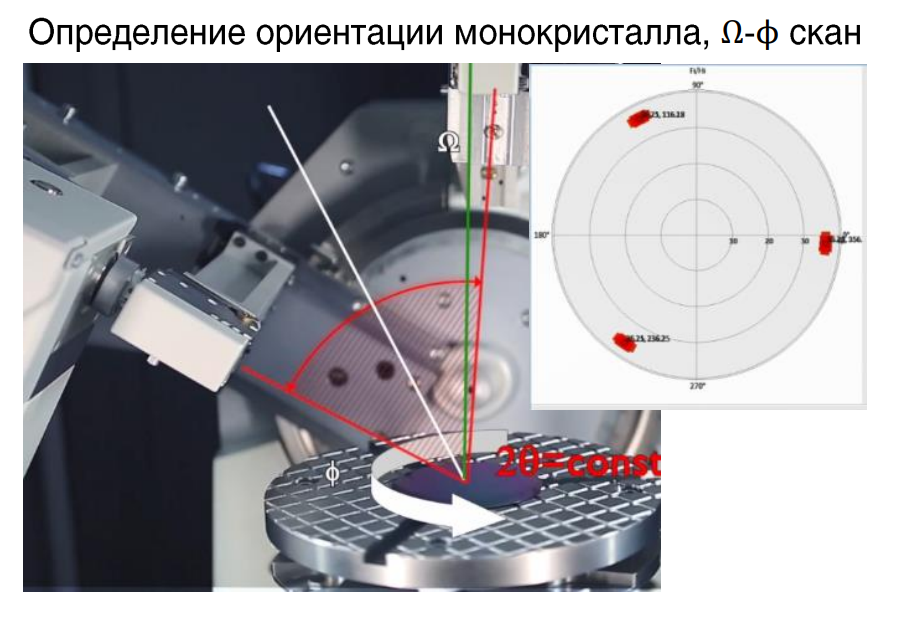
It is used to determine the orientation and quality of single crystals, to study the structure of epitaxial thin films, to analyze textures and residual stresses in Ω, Ω-ϕ, χ-ϕ, 2θ-Ω modes, as well as to analyze the phase composition and structural characteristics of objects of various shapes and sizes, including x-y scanning on their surface.


It allows mounting samples with diameter up to 100 mm, thickness up to 10 mm and weight up to 1 kg.


Two methods of sample mounting are realized:


- vacuum method of fixing for thin plane-parallel plates with a diameter of 10 to 100 mm and weighing no more than 150 g;

- clamp with variable depth for monolithic samples of irregular shape weighing up to 1 kg.


Main technical features:


  • automatic alignment of the specimen plane in horizontal position;

  • movement of the specimen plane along the z-axis in the range from -3 to +1 mm with an accuracy of at least 5 µm and a speed of at least 0.5 mm/sec;

  • φ-rotation in the specimen plane in the range of 360 deg. with discreteness not worse than 0.002 deg;

  • φ-angle rotation speed in the range from 0.5 to 30 deg/sec in continuous and discrete modes;

  • inclination of the sample plane by angle χ in the range from -5 to +95 deg. with discreteness not worse than 0.002 deg;

  • χ inclination speed in discrete mode not less than 2.5 deg/sec;

  • range of x and y displacements (in diagonal direction) in the sample plane not less than ±20 mm with a step not more than 0.1 mm.

Tunable motorized x-ray optical system for high resolution geometry

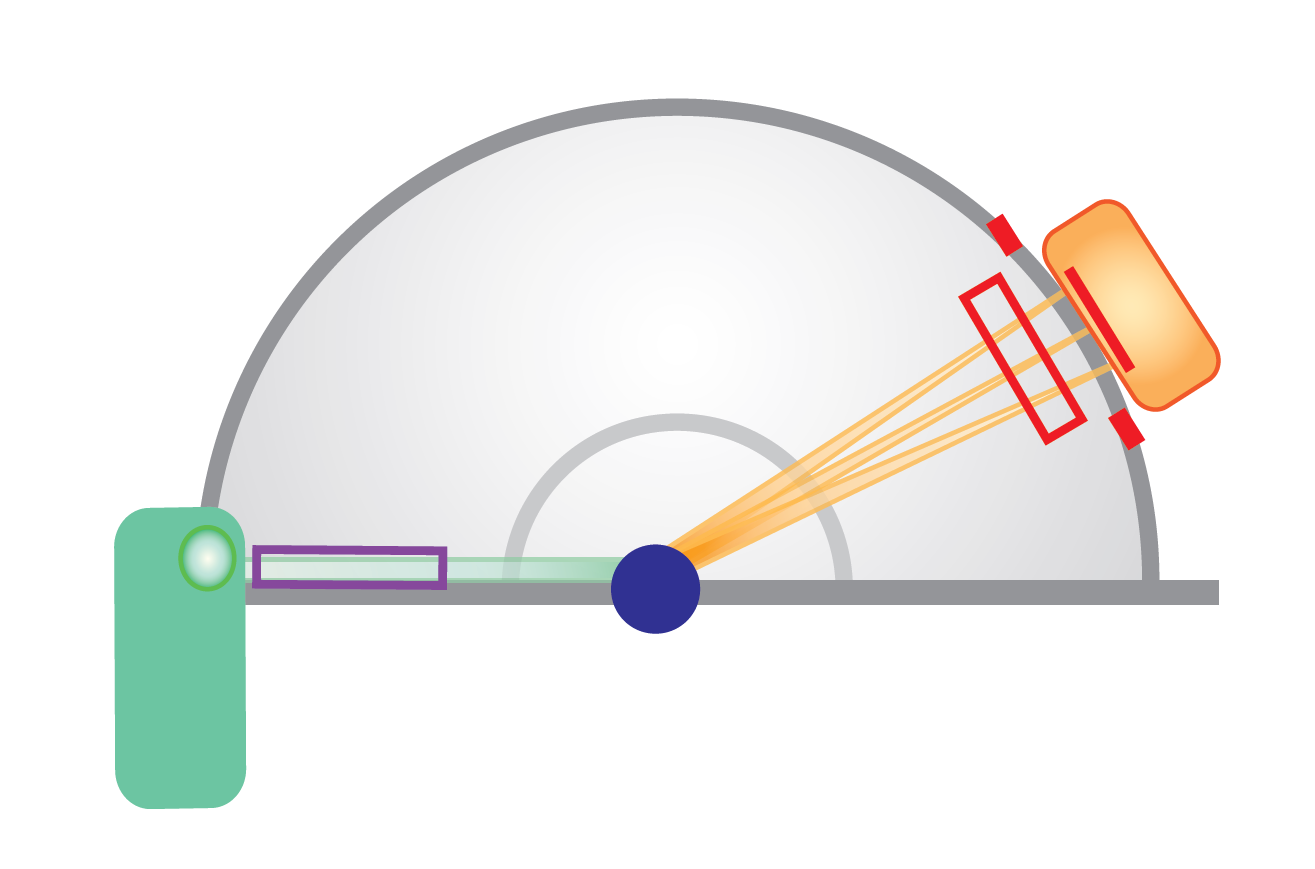
The motorized X-ray optical system (hereinafter - MOS) is designed for software control of primary beam collimation and provides reconfiguration for realization of various research methods in parallel-beam geometry and in high-resolution geometry.

The MOS consists of:


  • X-ray tube shroud movement mechanism

  • parabolic mirror;

  • automatic x-ray beam attenuator;

  • motorized primary beam monochromator;

  • motorized primary beam slit;


In combination with a multifunctional xyzχφ attachment, the motorized MOS allows measuring various polycrystalline and monocrystalline objects (powders, monolithic samples, coatings, monocrystalline plates, thin films, including epitaxial ones) to analyze their phase composition and structural features, including texture and stress state, orientation and quality at various points of the surface of the object under study. Tunable motorized X-ray optical system for high-resolution geometry 


Tunable motorized x-ray optical system for high resolution geometry

The motorized X-ray optical system (hereinafter - MOS) is designed for software control of primary beam collimation and provides reconfiguration for realization of various research methods in parallel-beam geometry and in high-resolution geometry.

The MOS consists of:


  • X-ray tube shroud movement mechanism

  • parabolic mirror;

  • automatic x-ray beam attenuator;

  • motorized primary beam monochromator;

  • motorized primary beam slit;


In combination with a multifunctional xyzχφ attachment, the motorized MOS allows measuring various polycrystalline and monocrystalline objects (powders, monolithic samples, coatings, monocrystalline plates, thin films, including epitaxial ones) to analyze their phase composition and structural features, including texture and stress state, orientation and quality at various points of the surface of the object under study. Tunable motorized X-ray optical system for high-resolution geometry 


Automatic alignment system for the X-ray optical system

Consists of the following major software-controlled components:


  1. motorized X-ray tube shroud slides;
  2. universal X-ray optical device holders on the primary and diffracted beams;
  3. motorized collimation slits on the primary and diffracted beams.

Also includes controller, control boards, communication cables and software.

Provides:

  • automatic alignment of the X-ray tube during its rotation and replacement;
  • automatic control of the collimation system on the primary and diffracted beams during measurements, including in the mode of constant area on the sample;
  • automatic alignment of the entire X-ray optical system during adjustment of the diffractometer;
  • exemption from radiation control and radiation safety of personnel.

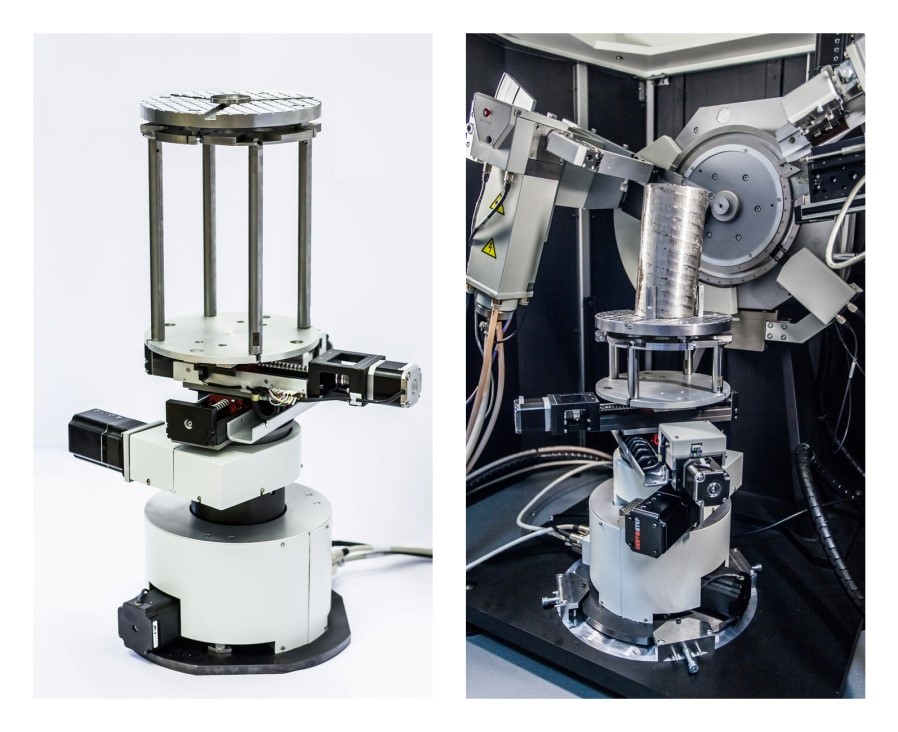
Four-axis xyzφ holder for large samples

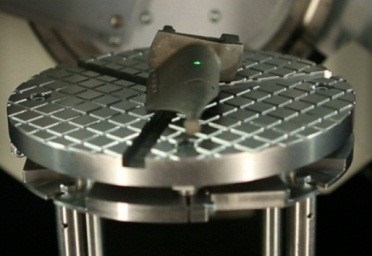
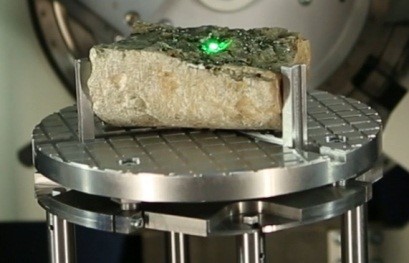
It is used to analyze the phase composition and structural characteristics of large-sized objects of various shapes and sizes, including surface scanning, as well as to determine the orientation of single crystals, analyze textures and residual stresses in Ω, Ω-φ, 2Θ-Ω modes.


Allows measurement of samples weighing up to 50 kg, with diameters up to 300 mm and heights up to 250 mm.


A standard powder cuvette can be fitted if required.


The automatic carriages of the holder ensure that the required area is brought out under the X-ray beam for measurements.


Application examples:


  • Analysis of residual stresses at various points on a turbine blade.

  • Determination of the mineral composition of ore and host rock directly in the core without destroying it.

  • Determination of orientation of single crystals and products made of them.


Main technical characteristics:


  • program-controlled vertical movement z:

- displacement range, mm: not worse than ± 20;

- positioning accuracy, µm: not worse than ± 5;


  • program-controlled movement xy (in two perpendicular directions in the sample plane):

- movement range, mm: ± 100;

- positioning accuracy, mm: not worse than ± 0.1;


  • program-controlled rotation φ (or rotation at a specified speed) in the sample plane:

- rotation speed, rpm: from 0.5 to 30;

- positioning accuracy, deg: not worse than ± 0.001.


  • automatic alignment of the specimen plane in the range from - 20 to + 5 mm with an accuracy of 5 µm.


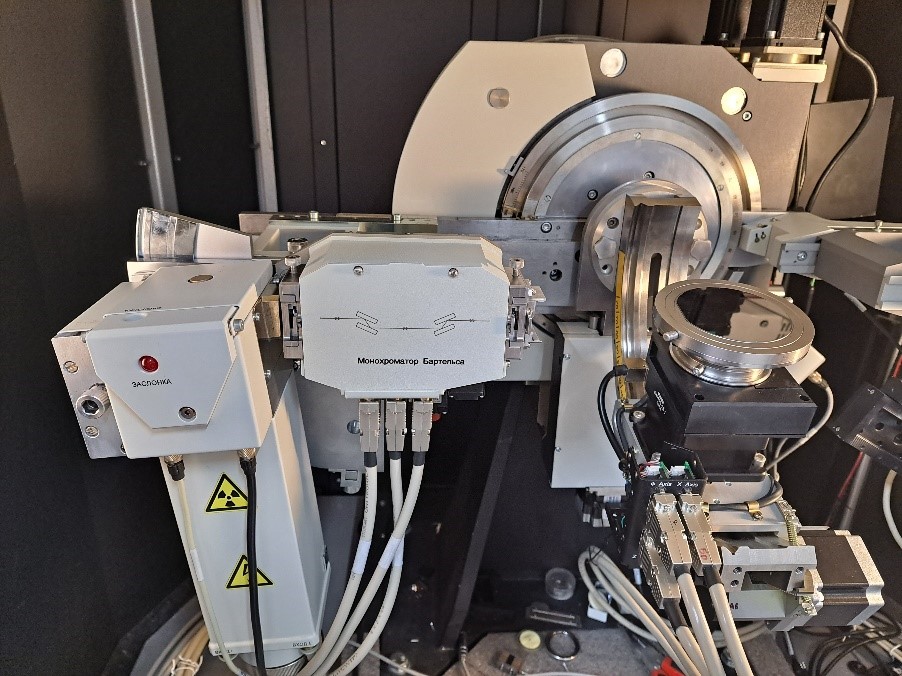
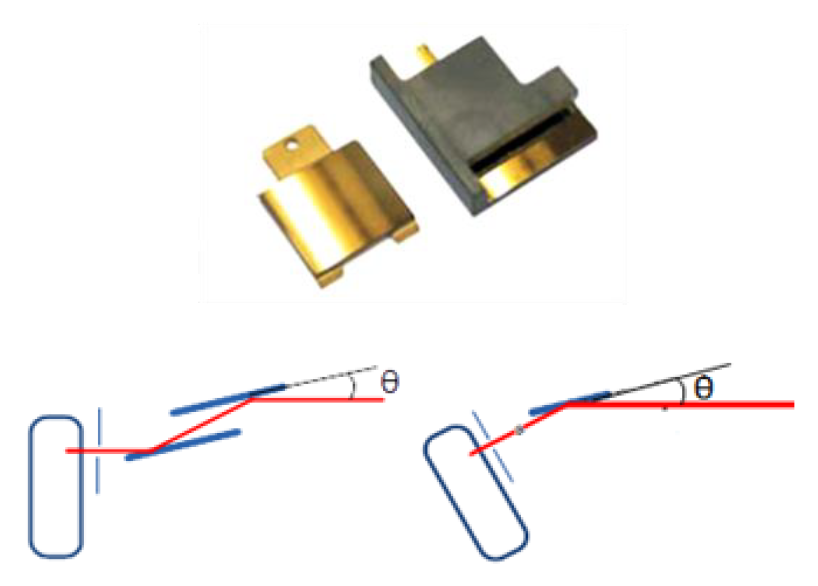
Four-bounce Ge 220 x 4 channel-cut monochromator (Bartels type)

бартельс1.jpg


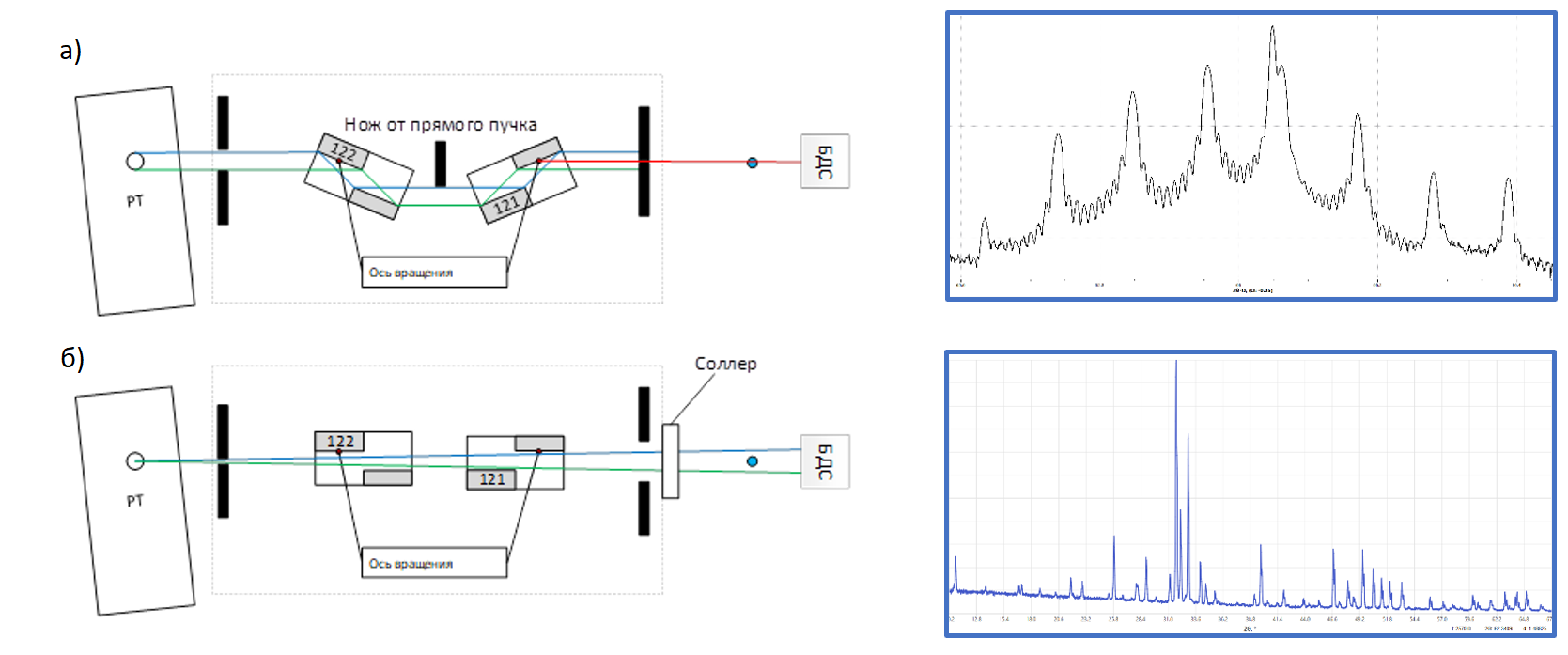
The motorized fourfold Bartels Ge 220 x 4 slit monochromator mounted on the primary beam produces a monochromatic Ka1 line with an angular resolution not exceeding 12 arc sec.

It is used only for copper radiation. It is used for studies of epitaxial nanoheterostructures and high-quality single crystals.

Software-controlled crystal tuning provides switching between geometries


  • high resolution (a) and
  • parafocusing Bragg-Brentano (b) 
for studies of polycrystalline objects.

бартельс 111.PNG

High temperature chamber HTK 16N/2000N with strip heater

High-temperature chamber HTK 16N/2000N with a strip heater is used for in situ studies of phase transformations, chemical reactions and thermal deformations of the crystal lattice at heating from +25 to +1600/+2300 оС (depending on the heater material and atmosphere).


Mounted on the movement mechanism (elevator) to bring the sample plane to the goniometer axis.


Operating temperatures:

HTK 16N

HTK 2000N

25 °- 1600 °C

Pt heater;

in vacuum, in air

25 - 2300 °C

Heater made of W;

in vacuum

25 - 1500 °C

Ta heater;

in vacuum

25 - 1600 °C

Pt heater;

in vacuum, in air

25 - 1500 °C/1300 °C

Graphite heater;

in vacuum/helium;

25 - 1500 °C

Ta heater;

in vacuum

Scanning angles 2Θ: 4 - 164°

Measurement geometry: reflection

Sample size: 10 x 0.1 mm2

Pressure: ≤2.10-4  mbar to 0.5 bar
Low temperature chamber TTK-600

Low-temperature chamber TTK-600 is designed for in situ studies of phase transformations, chemical reactions and thermal deformations of the crystal lattice during cooling and heating in the temperature range from -190 to +600 0C.

Operating temperatures:

  • -190 ˚C to 600 ˚C - liquid nitrogen cooling

  • -10 ˚C to 600 ˚C - compressed air cooling

Atmosphere: vacuum (10-2 mbar) – optional air, inert gas.

Scanning angles: 0 - 164° 2Θ

Specimen holder: 14 x 10 mm, nickel-plated copper, removable, without rotation

Mounted on the transfer mechanism (elevator) to align the specimen plane to the goniometer axis.

Motorized X-ray tube housing

Motorization of the X-ray tube casing for remote adjustment during tube replacement in machines.

It has two program-controlled movements - linear movement and rotation.

Three-axis φχz attachment with inclination

Three-axis φχz attachment is used for texture and stress analysis of polycrystalline materials.

Orientation of single crystals can be determined also.

Samples with diameter up to 100 mm, thickness up to 2 mm and weight up to 1 kg can be installed. 

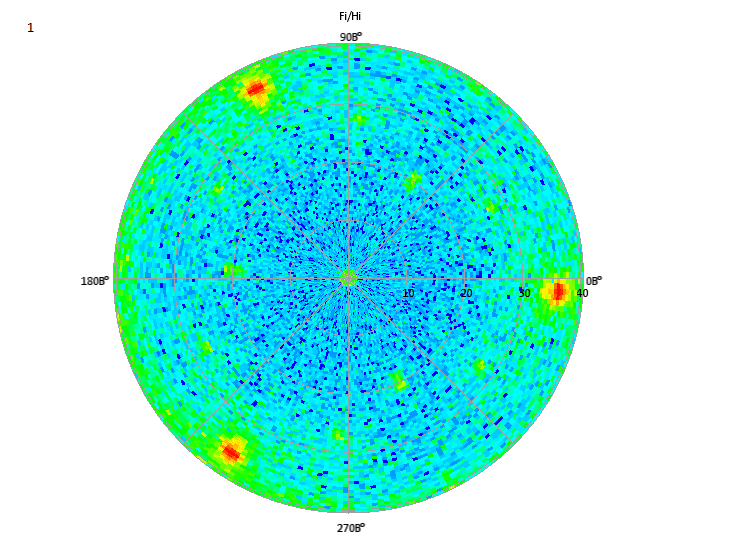
Two-dimensional intensity distribution of hkl reflection is measured to build pole figures in φ-χ coordinates.

The attachment can be also used for analysis of phase analysis of polycrystalline samples.

The attachment has three types of changeable sample holders: 


  • Vacuum chuck for substrates;

  • Cell for powders;

  • Clump for bulk samples with irregular shape.


Technical specification:


Axis

Range

Minimal

step size

Scanning rate

Scanning mode

χ

from -3 to +75o

 0,01o

not less than 2,5 о/sec

discrete

φ

360

0,05o

from 0,5 to 30 о/sec

discrete or continuous

z

from -3 to +1 mm

5 μm

not less than 0,5 mm/sec

discrete


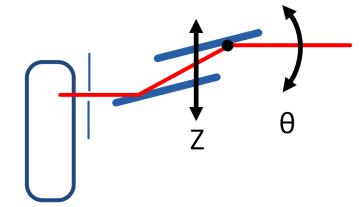
Universal motorized monochromator holders
1.png
Mounted on the primary and/or diffracted beam;
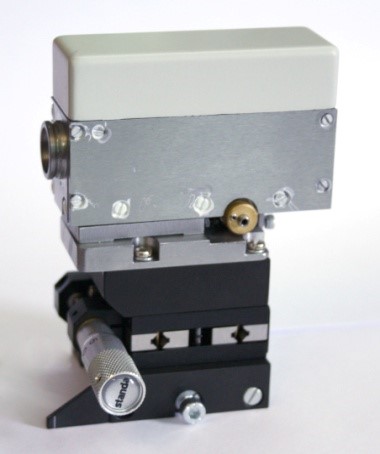
- Have two motorized slides for software-controlled adjustment;

- Designed for monochromatization of any X-ray radiation (from Mo to Cr);

- Allows mounting flat or slotted monochromator crystals made of any material (Ge, Si, SiO2, LiF, graphite, etc.) in any orientation (111, 100, 110, etc.);

- Remove the background and B-line;

- Separate the monochromatic Kα1 line with a slit crystal monochromator;

- When two Ge 220 monochromator cut-through crystals are installed simultaneously on the primary and diffracted beams, the X-ray diffractometer system provides measurements in high-resolution geometry with separation of the monochromatic Kα1 line with an intensity of more than 1.5 million imp/s and angular resolution not worse than 12 angular sec.

8.PNG

7.PNG


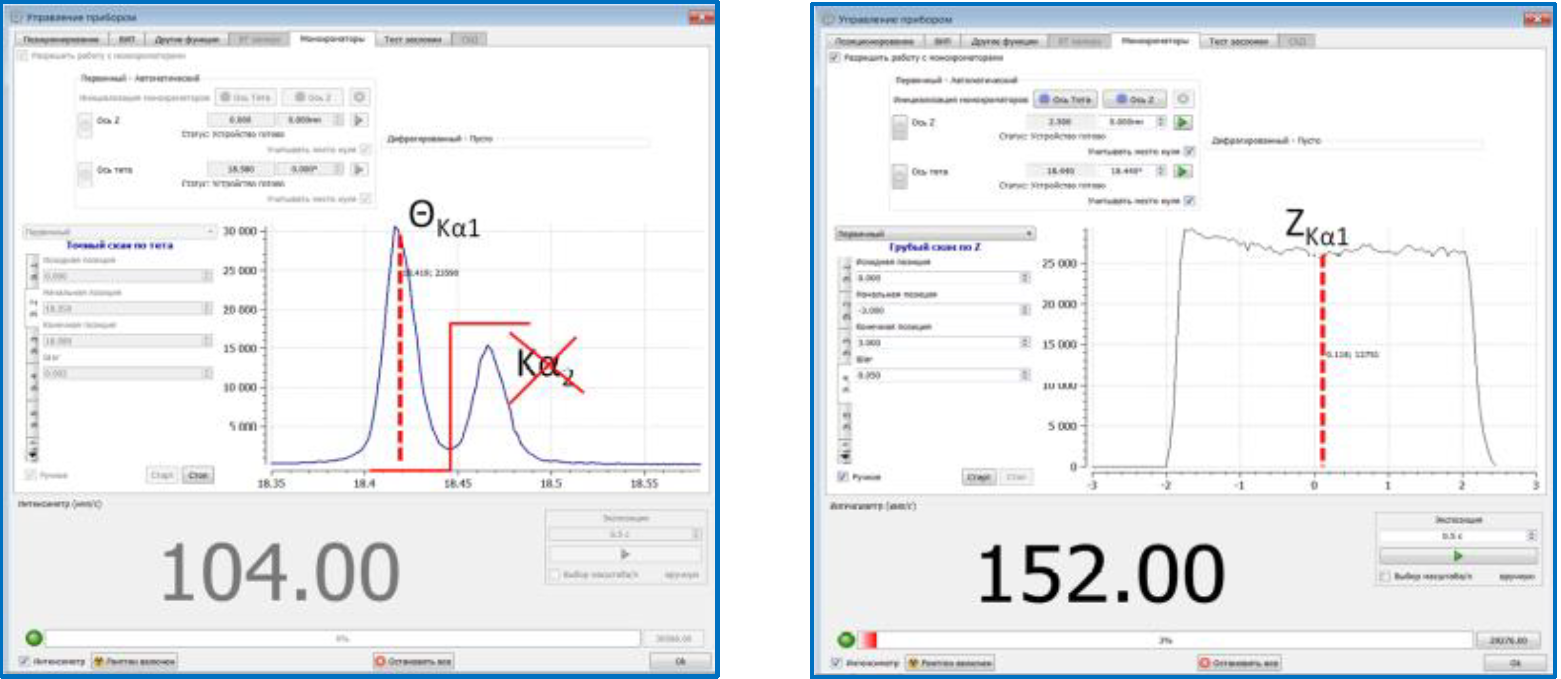
Software control of alignment                                                                     


- Monochromator rotation angle adjustment θ;

- Monochromator height adjustment Z;

- Kα1 line extraction;

- Ensuring radiation safety


2.png


Three-axis xyφ attachment with carriages

Three-axis xyφ attachment is used for analysis of phase composition and structural characteristics in different points of sample surface.


Polycrystalline and single crystal samples with diameter up to 100 mm, thickness up to 20 mm and weight up to 1 kg can be installed.  


Orientation and quality control of single crystals from rocking curves can be performed also.


Technical specification:

Axis

Range

Minimal

step size

Scanning rate

Scanning mode

φ

360о

 0,01o

from 0,5 to 15 о/min

Discrete or continuous

x, y

50 mm

0.1 mm

10 mm/sec

Discrete

Vacuum system

The vacuum system is an additional device for the high-temperature chamber and is equipped with two vacuum pumps: 

rotary and turbomolecular to create inside the high-temperature chamber:

  • low (<2x10⁻³ mbar) and

  • high (<8x10⁻⁹ mbar) of the vacuum.

X-ray optical system with parabolic mirror for parallel-beam geometry (Göbel Mirror)

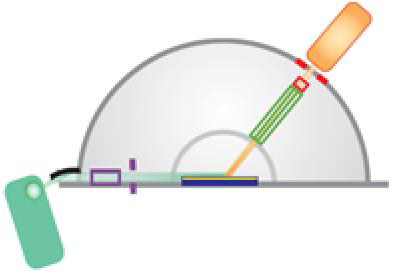
The X-ray optical system with one-dimensional parabolic mirror for switching to parallel-beam geometry. 


It monochromatizes primary beam and enhances its intensity.


It is recommended to use a parallel-beam geometry to measure objects with uneven surface and to perform SAXS, XRR and GID studies of nanoparticles, thin films and coatings.


Equatorial Soller slit with the divergence of 0.4°

 соллер1.jpg    соллер2.png


Equatorial Soller slit with the divergence of 0.4° is used for measurements of polycrystalline thin films and coatings in parallel-beam and grazing-incident (GID) geometries.

It is installed on the diffracted beam and makes its quasi-parallel to enhance angular resolution of X-ray optical scheme..

Working area of the slit is 3х10 mm2.

Plates are made from tantalum .


соллер3.png

Configuration with a parabolic mirror and equatorial Soller slit for transition to sliding beam geometry. 


соллер4.png

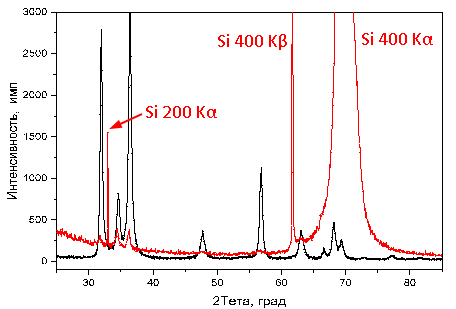
X-ray radiographs of a 60 nm thick ZnO thin film on a single-crystalline silicon substrate (100) measured in Bragg-Brentano geometry (red line) and in sliding beam geometry (black line). 

Motorized equatorial slit on the primary beam

пуч1.jpg  


Mounted on the primary and/or diffracted beam.


Provides control of X-ray beam collimation during measurements, including in the mode of constant area on the sample.


Slit width range: 0-4 mm.


Minimum step: 0.01 mm.

Also included:

  • controller;

  • control board;

  • communication cables;

  • software.


мэщп.PNG

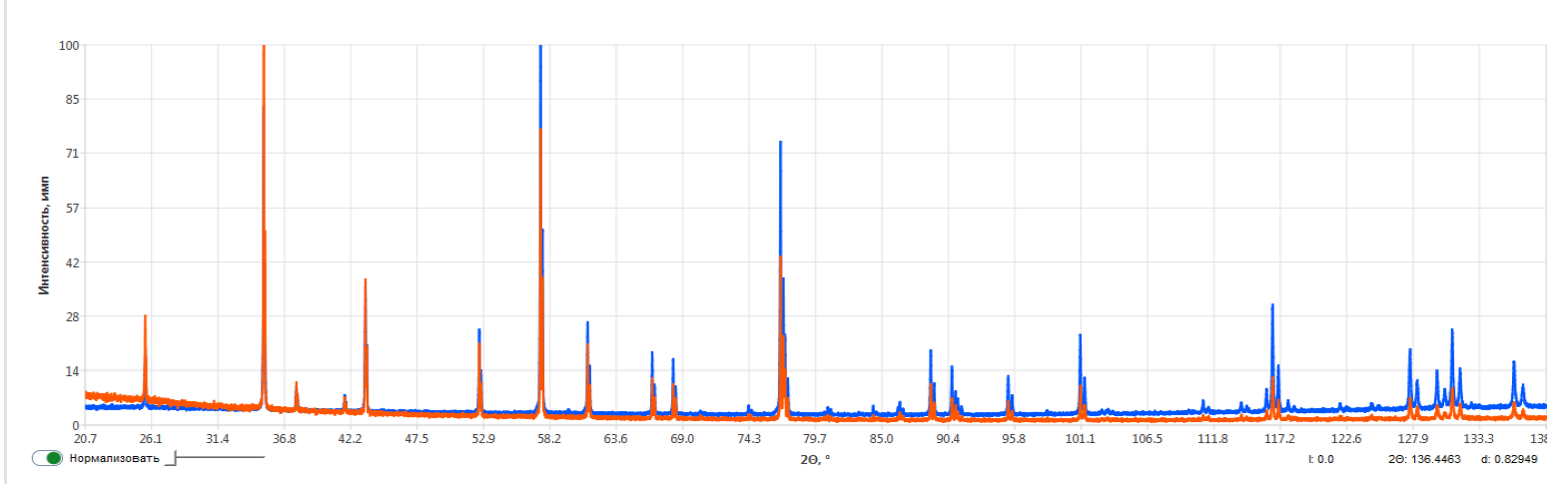
Comparison of the corundum rentegnogram measured in constant slit mode (red) and in constant area mode on the sample (blue)
Versatile stage for SAXS and XRR

For measurements in reflection and transmission geometry including SAXS and XRR.

Various types of samples:

  • bulk samples and thin films up to Ø 100 mm;

  • capillaries Ø 1, 0.5 and 0.1 mm;

  • small glasses with thin films;

  • cuvettes for liquids and gels. 

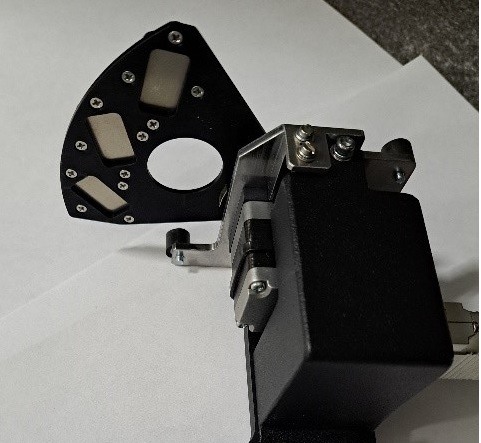
Automatic attenuator for primary beam

The automatic attenuator is installed on the primary beam path and has 4 automatically switchable positions providing the following fixed attenuation values: 1, 150, 800, 3000.


Attenuator control is integrated into the control and data acquisition system of the diffractometer and provides:

  • automatic control of X-ray beam attenuation during measurements and correction of the measured intensity values by the value of the inserted attenuation; intensities for introducing absorber into the beam and for its removal from the beam;
  • user selection of the position with absorber to be used in subsequent measurements;
  • user setting of intensity thresholds for introducing absorber into the beam and for its removal from the beam;
  • user setting of intensity thresholds for introducing absorber into the beam. 


Attenuator control in integrated into the diffractometer software to provide automatic choice of position depending on current intensity with the corresponding correction of measured data.
Two-axis χφ PGTM attachment

The attachment is designed for analysis of textures residual stresses in polycrystalline samples up to 28 mm in diameter and for the determination of single crystal orientation as well. 

It enables two independent computer-controlled sample movements:


-               rotation range around φ- axis - from 0 to 360°,

-               inclination range around χ-axis - from –3 to +70°.


Within the diffractometer, it enables data collection by Ω-φ rotation or by χ-φ inclination methods in the above ranges, as well as data collection by χ-φ inclination at fixed 2θ angle or with 2θ–θ method at fixed (χ, φ) position.

This allows determination of single crystal orientation, enables bringing a certain Bragg reflection into the fixed (χ, φ) position and perform 2θ–θ scan of the reflection to refine interatomic distance in a given direction.

Single-axis φ-attachment

Single-axis φ-attachment is used to determine the orientation of single crystals, to analyze textures and residual stresses in Ω, Ω-φ, 2Θ-Ω modes, as well as to analyze the phase composition and structural characteristics of objects of various shapes and sizes, including powder samples.

It allows measuring samples up to 100 mm in diameter and 20 mm in height. 


Automatic adjustment of the sample plane by the position sensor within the range from - 5 to +20 mm with an accuracy of 5 µm. 

Discreteness of φ-rotation is 0.001 deg. 

The φ-rotation speed is from 0.5 to 30 rpm.

Versatile monochromator holder for diffracted beam

Versatile monochromator holder for diffracted beam is mounted on the detector bracket.

It can be applied to any X-ray radiation from molybdenum to chromium to monochromatize it.

Flat crystals from various materials, including pyrolytic graphite can be installed in the holder.

It is recommended for measurements of polycrystalline samples.

Different types of crystals-monochromators

Flat monochromator crystals are cut from Si or Ge single crystals in different orientations (111, 220, 200). 


They are fixed in mandrels or on substrates. 


The size of the crystals is 20 x 22 mm2.


Cut monochromator crystals are cut from Si or Ge single crystals in different orientations (111, 220, 200). 


They are fixed in mandrels.


Monochromator crystals can be installed in the seats of universal monochromator holders on the primary and diffracted beams.


Monochromators are usually used for quality studies of single crystals at various radiations (from Mo to Cr). as well as for studies of epitaxial thin films.

Gandolfi attachment

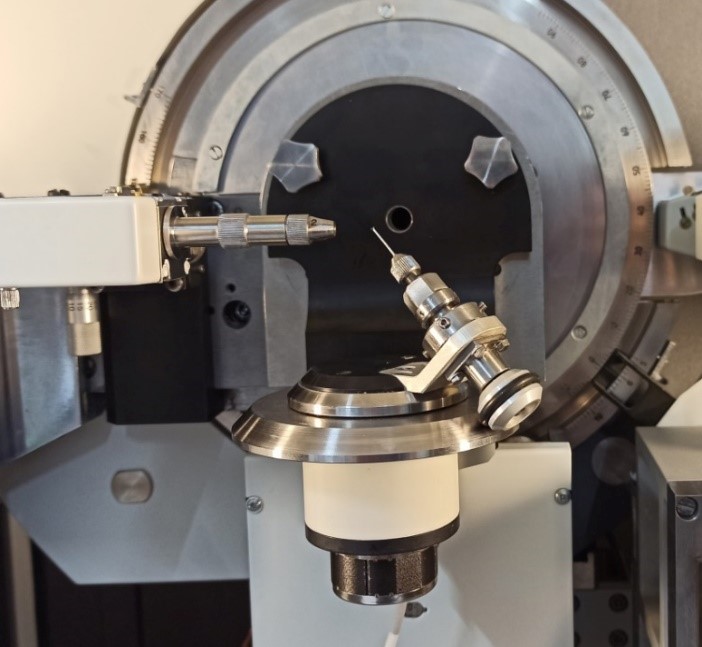
The Gandolfi attachment is designed for measuring powder X-ray radiographs from randomly shaped single-crystal grains not larger than 1-2 mm.


The attachment is a replaceable sample holder with a goniometric head having two axes of rotation - one motorized and one driven, located at an angle of 45 degrees, and two manual linear movements in mutually perpendicular directions to center the sample.


The attachment provides rotation of the specimen simultaneously in two directions at an angle of 45 degrees with a constant speed in the axis φ in the range from 10 to 120 rpm, controlled from the interface of the control program and data acquisition.


The center of rotation of the sample is aligned with the X-ray diffractometer's X-ray optical axis by the shadow of the crystal on the primary beam.


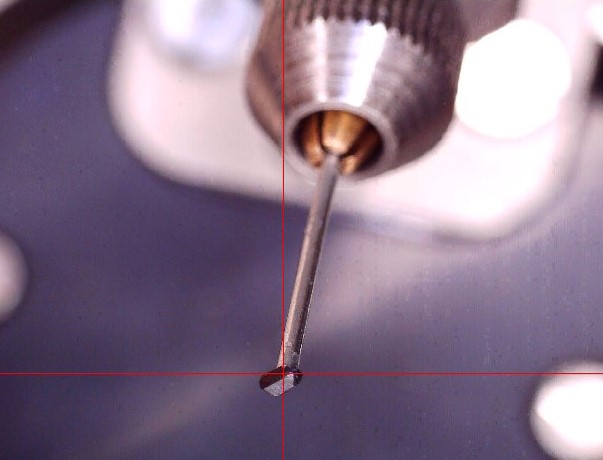
The kit also includes a fixture for mounting the Gandolfi attachment on the operator's table, which provides 360 degree rotation of the sample around the phi axis and is equipped with a visualization system for fixing and centering the sample.


The Gandolfi attachment is used in conjunction with a rapid logging system to optimize measurement time and provide data suitable for analysis.

Autosampler

Autosampler for 6 positions for flow measurement of powder or monolithic samples (diameter up to 28 mm, thickness up to 25 mm) on the diffractometer.


  • automatic alignment of the sample plane before measurement (as directed by the user);

  • rotation speed of the sample in its plane: 0.5 or 1 rpm/sec.

β-filters for monochromatization of various X-ray radiations

Monochromatization of X-ray radiation of tubes with different anodes at installation of a point or position-sensitive detector.


Dimensions of active area of filters:


for point detector - 10x15 mm

for PSD - 8x32 or 8x64 mm

Cylindrical sample holder (capillaries)

Holder of cylindrical samples (capillaries) with a diameter of 0.1-1.0 mm.

Designed for lumen measurements of powder samples in Debye-Scherrer geometry. 


The holder provides rotation of the capillary during imaging.


It is equipped with a goniometric device with two perpendicular angular slides for capillary adjustment.


It is equipped with a video camera for visualization of the sample when it is installed in the holder.


It is recommended to use in combination with a linear PSD.

Calibration cuvette with a cup cut from silicon (111) single-crystal
Calibration cuvette cut from silicon (111) single crystal with a cup Ø 10-15 mm for filling in with a powder. Reference hhh reflections from silicon are used for calibration of X-ray diffraction powder patterns measured in wide angular range.
Cuvette with variable depth for bulk samples

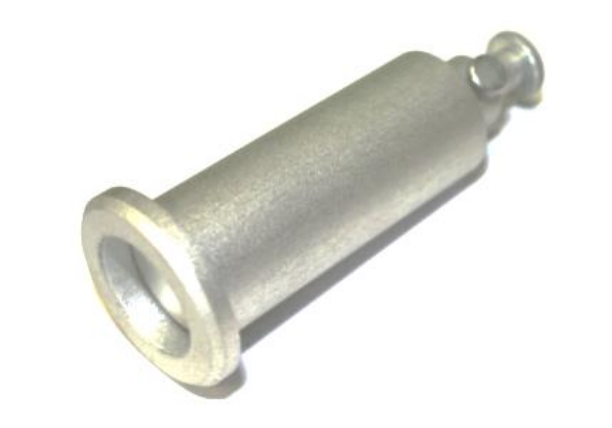
Cuvette with changeable depth to measure bulk samples and single crystals of different shape with up to 20 mm in diameter up to 60 mm long.


Fast registration system with Mythen 2 R 1D linear PSD
Linear strip position-sensitive detector Mythen 2R 1D (Dectris, Switzerland) with holder, slit device and primary beam trap.

The system provides 50 times faster apparatus performance than with a point detector (a few minutes instead of several hours of measurements to obtain good data statistics).

The system also includes a collimation system on the diffracted beam and a primary beam trap to provide measurements at near angles (from 3 deg.).

The PSD is particularly effective for studies of poorly oxidized, rapidly decomposing objects or small amounts of matter.

It is indispensable for in situ studies of chemical reactions and phase transformations in combination with high- and low-temperature attachments and for data acquisition for residual stress analysis.

Characteristics of the Mythen 2R 1D PSD:

  • sensor: silicon diode array;
  • strip size: 50 µm ± 3 µm;
  • number of channels: 640;
  • active area: 8 x 32 mm2;
  • count rate per channel: > 1 x 106;
  • energy range: 4 - 40 keV;
  • efficiency (for 8 keV): 96%;
  • cooling: air.

Kit for installation of two detectors

Provides:


simultaneous installation and fast switching between point (scintillation) and linear position-sensitive detectors directly in the software interface;

angular range for linear position-sensitive detector - -10 to +140°;

angular range for scintillation detector - -10 to +165°.

Low background cuvette with polished surface cut from silicon (911) single crystal
Low background cuvette with polished surface cut from silicon (911) single crystal is used for measurements of small amounts of material.
Low background polished wafer Ø25 * 1 mm cut from silicon (911) single crystal
Low background wafer is used for measurements of minor quantities of polycrystalline substances. It is installed in a quartz cuvette 2 mm deep.
Low background wafer Ø25 * 1 mm with a cup of Ø12 * 0.5 mm cut from silicon (911) single crystal
Low background wafer is used for measurements of minor quantities of polycrystalline substances. It has a cup for filling in with a powder. It is installed in a quartz cuvette 2 mm deep.
Low background wafer Ø25 * 1 mm with a cup of Ø20 * 0.5 mm cut from silicon (911) single crystal
Low background wafer is used for measurements of minor quantities of polycrystalline substances.. It has a cup for filling in with a powder. It is installed in a quartz cuvette 2 mm deep.
Motorized equatorial slit on the diffracted beam

Installed on the diffracted beam in front of the scintillation detector;


Provides collimation control of the X-ray beam during measurements.


Slit width range: 0-4 mm.


Minimum step: 0.01 mm.

Also includes:


  • controller,

  • control board,

  • communication cables

  • software.

Quartz cuvettes of various depths
Quartz glass cuvettes for pressing powder samples or for mounting small plates. The cuvette has a recess with a diameter of 28 mm and a depth of 0.5, 1 or 2 mm.
Automatic attenuator for primary beam

The automatic attenuator is installed on the primary beam path and has 4 automatically switchable positions providing the following fixed attenuation values: 1, 150, 800, 3000.


Attenuator control is integrated into the control and data acquisition system of the diffractometer and provides:

  • automatic control of X-ray beam attenuation during measurements and correction of the measured intensity values by the value of the inserted attenuation; intensities for introducing absorber into the beam and for its removal from the beam;
  • user selection of the position with absorber to be used in subsequent measurements;
  • user setting of intensity thresholds for introducing absorber into the beam and for its removal from the beam;
  • user setting of intensity thresholds for introducing absorber into the beam. 


Attenuator control in integrated into the diffractometer software to provide automatic choice of position depending on current intensity with the corresponding correction of measured data.
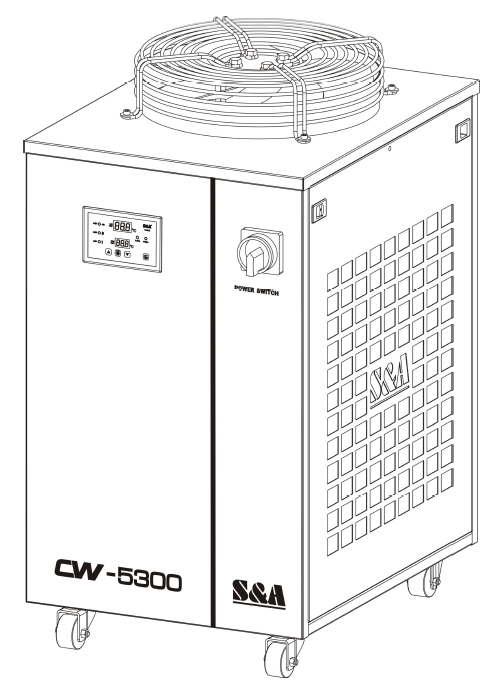
Cooling system (chiller)

Autonomous cooling system of refrigerator type (air-water type).


Provides cooling of the X-ray tube with distilled water through a closed circuit, maintains the water temperature with an accuracy of 0.5 degrees Celsius.

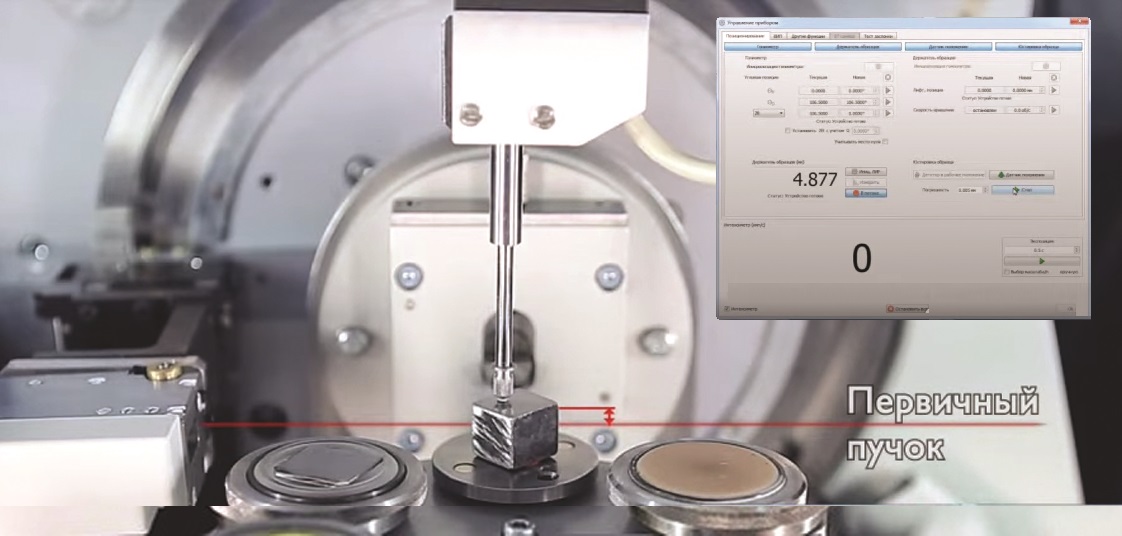
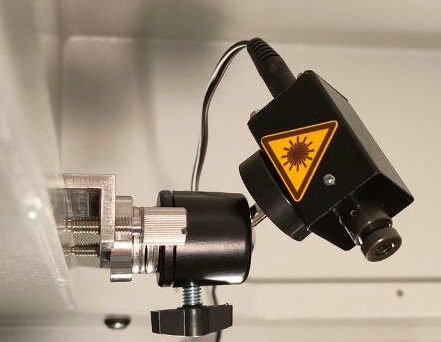
Laser beam indicator

The device is used to visualize the location of the X-ray beam incident on the sample for local analysis of phase composition and structural characteristics in different parts of its surface.


The option is installed inside the safety cabinet and is usually used in conjunction with xy-scanning consoles.

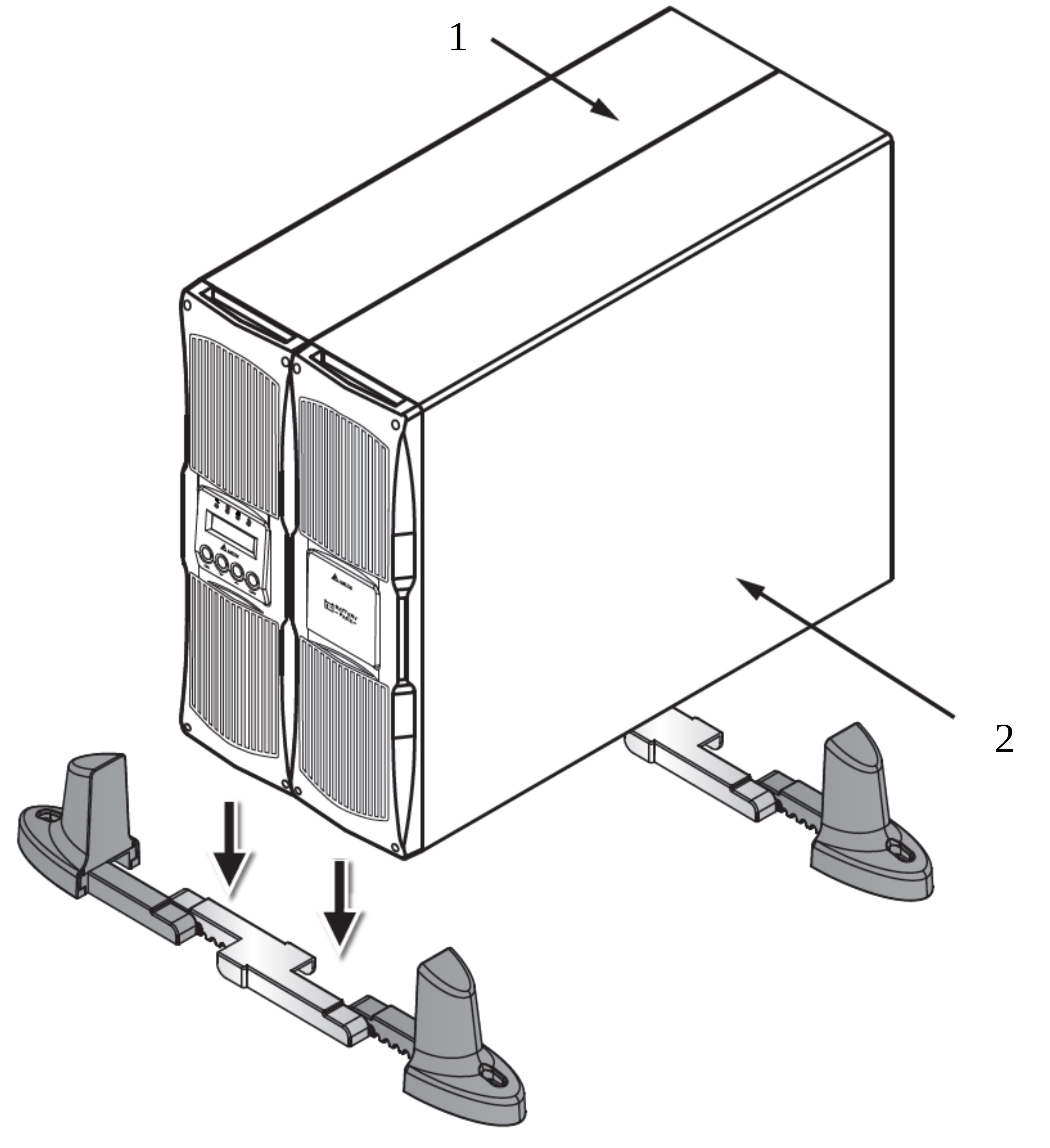
Uninterruptible power supply kit

Uninterruptible power supply kit is designed to ensure uninterrupted operation of the diffractometer DRON-8N/DRON-8T in the basic configuration or with a set of options.


Includes UPS (Uninterruptible power supply unit Delta Electronics GES103R212035 with battery pack GES201B109700.) 


and a set of mounting parts to connect it to the electrical (supply) network on the customer's premises. 


Provides 1 hour of autonomous operation of the apparatus with a power consumption of 5 kW.

Video system

The video system is designed for visualization of microobjects on the sample surface.

It is fixed inside the protective cabinet of the diffractometer on a bracket.

Visualization of the object is integrated into the control and data acquisition program of the diffractometer.

Software

Analytical
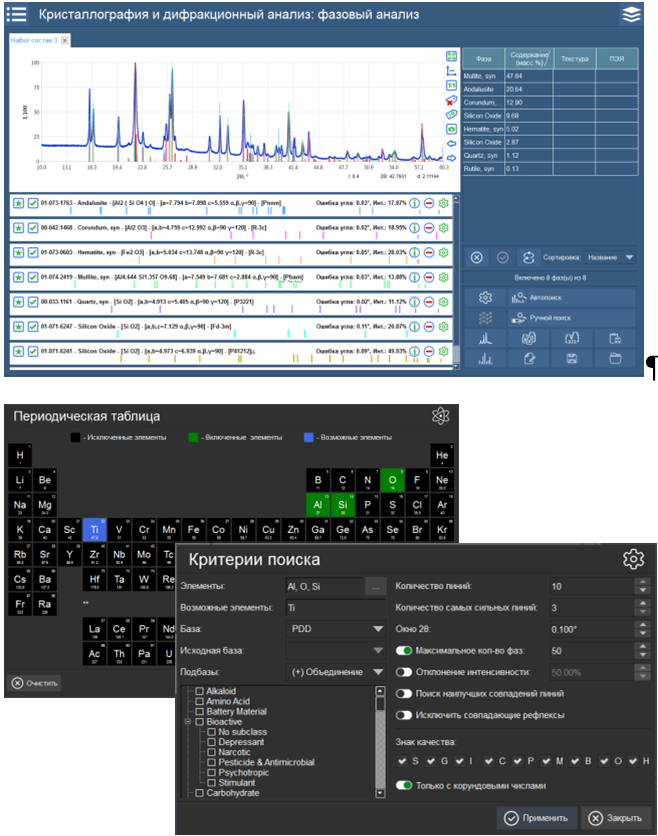
“Crystallography and Diffraction Analysis” (CDA) analytical software suite
Software for X-ray phase analysis with built-in set of powder standards
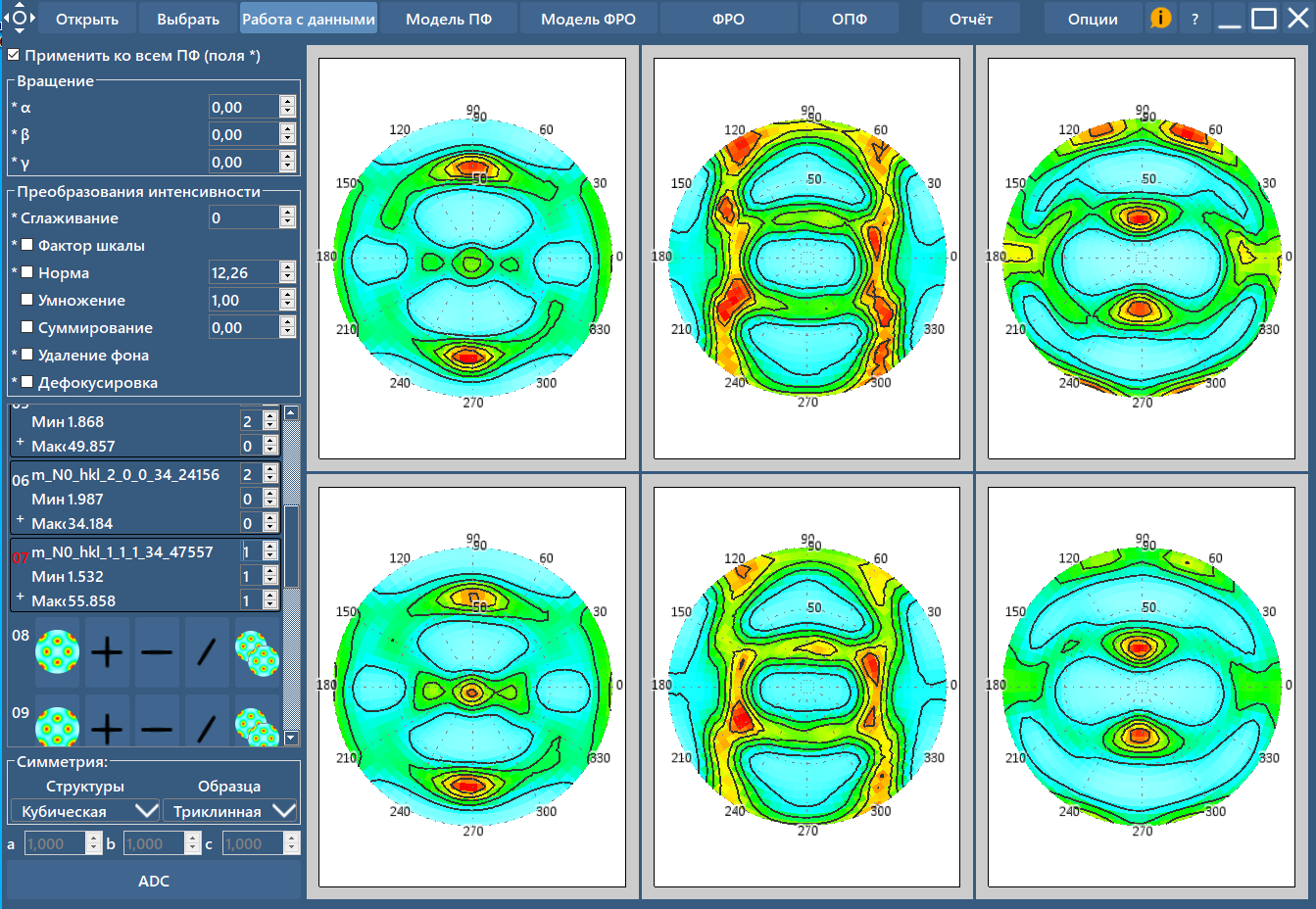
Software for texture analysis
«XRR simulation – Simulation of reflectivity curves » Software
Qualitative and quantitative phase analysis by COD basis
Reverse space maps - RSM
Сontrolling
Software package for management and data collection
Software option “XY-mapping”
Crystallographic complex PDWin
«Size&Strain – Calculation of average size of coherent domains and of microstrains» Software
«DrWin – Data processing» Software
«High temperature-X-ray diffraction» Software Suite
«Ind – Auto indexing» Software
«MacroStress – Residual stress analysis» Software
«Param – Refinement of unit cell parameters» Software
«Rietveld – Rietveld method» Software
«TheorPattern - Calculation of theoretical diffraction pattern» Software
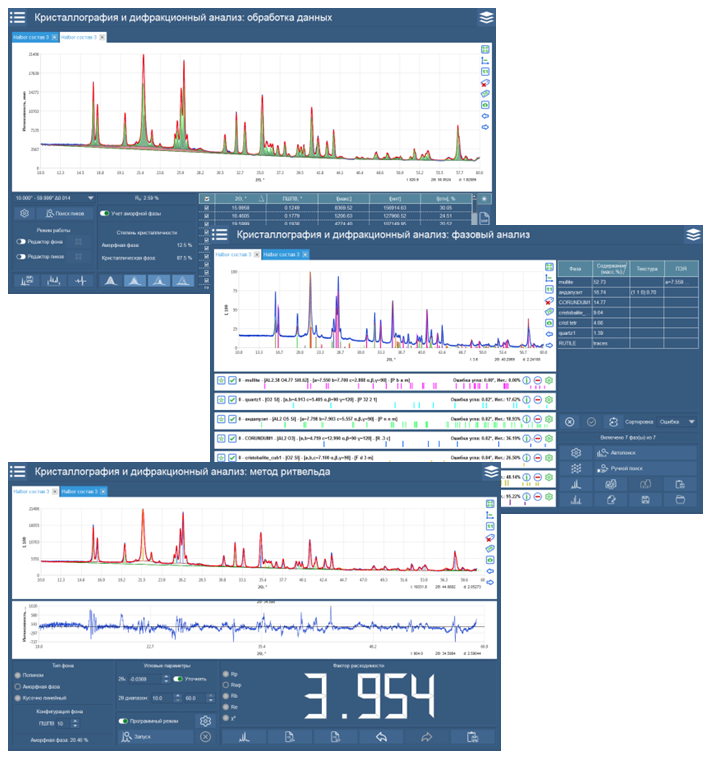
“Crystallography and Diffraction Analysis” (CDA) analytical software suite

Includes the following modules for processing and analysis of XRD powder patterns: 

  • raw data management and comparison;
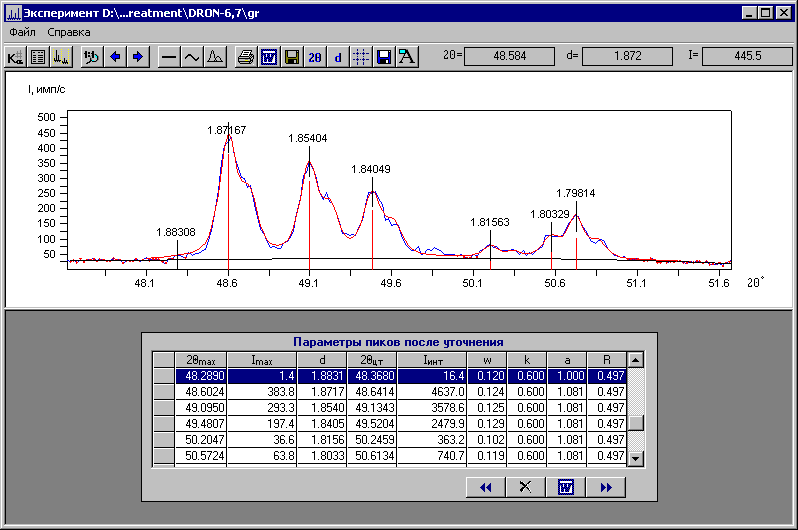
  • processing of powder patterns (approximation of instrumental and physical backgrouond, peak search, doublet separation, intensity calculation);
  • evaluation of crystallinity degree (content of amorphous phase);
  • qualitative and quantitative phase analysis with COD database;
  • refinement of lattice constants;
  • calculation of theoretical powder pattern;
  • structure refinement and quantification of mixtures by Rietveld full-profile analysis;
  • evaluation of crystallite size and lattice microstrains.


Software package for management and data collection

The program complex is designed for measuring X-ray diffraction spectra on the diffractometer DRON-8 with various optional devices (attachments, cameras, etc.).

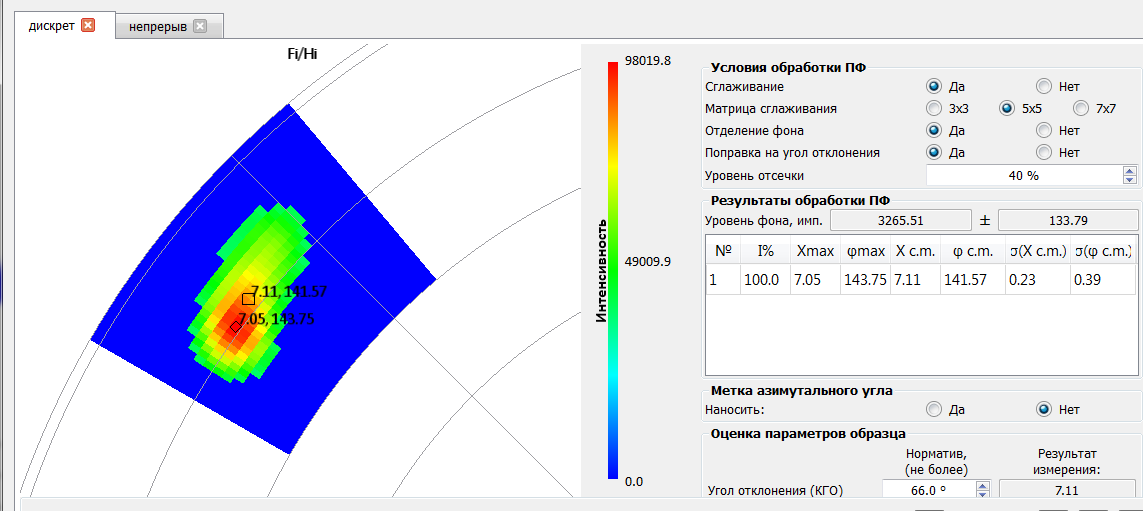
The program complex controls different configurations of the diffractometer, collects data in continuous or step-by-step mode with different algorithms of interaction of controlled mechanisms and actuators, as well as saves the measured data in the form of a data file of different format.

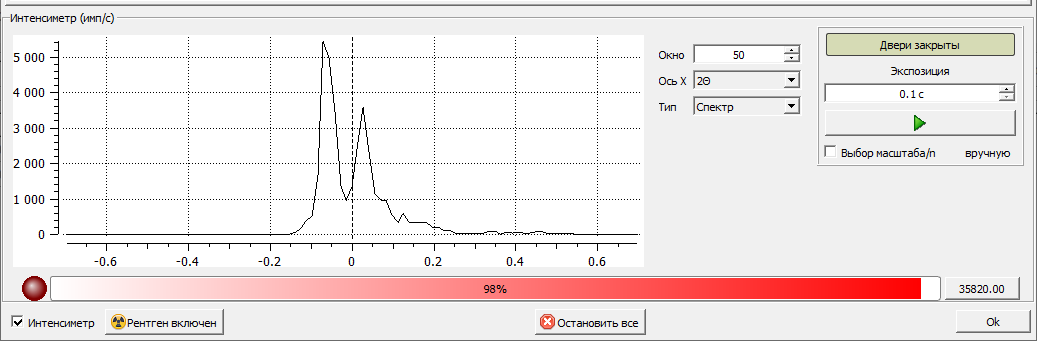
The program has a graphical interface for on-line visualization of measured spectra, Russian and English language interface with built-in help system in Russian.

The program functions in Windows 10 operating systems.

It is protected from unauthorized access, which can lead to distortion of measurement results.


The program complex provides:
  • control and condition monitoring of the main units and mechanisms of the diffractometer;
  • diagnostics and working out of emergency situations arising during the operation of the diffractometer and its actuating mechanisms;
  • automatic construction of the detector amplitude distribution curve
  • step-by-step and continuous measurement of the diffraction spectrum in a given angular range with a given exposure (or scanning speed) at θ-θ, θ, Ω, 2θ-Ω-scanning;
  • measurement with multiple scanning of different angular intervals with subsequent averaging or summarizing of the results.

Specialized software complex for data collection and processing provides (if appropriate attachments are available):

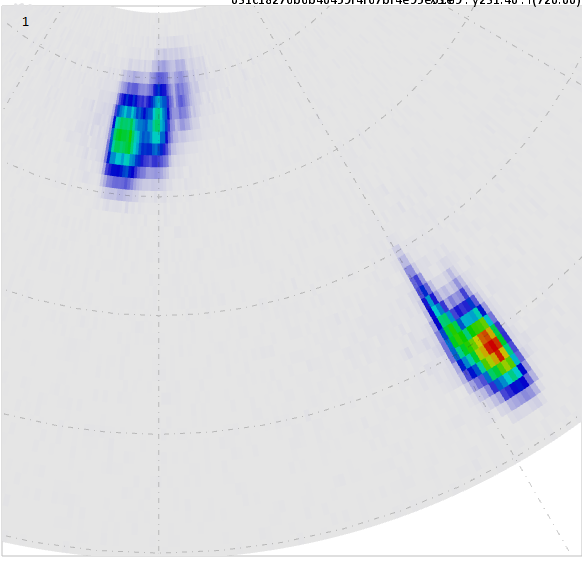
  • fast search of reflexes by omega-phi and/or chi-phi methods;
  • determination of (Ω, φ)- and/or (χ, φ)-coordinates of the found reflexes;
  • rotation of the sample around its axis by the specified angle φ;
  • setting of goniometer and attachment drives to the specified (Ω, φ)- and/or (χ, φ)-coordinates of the required reflex;
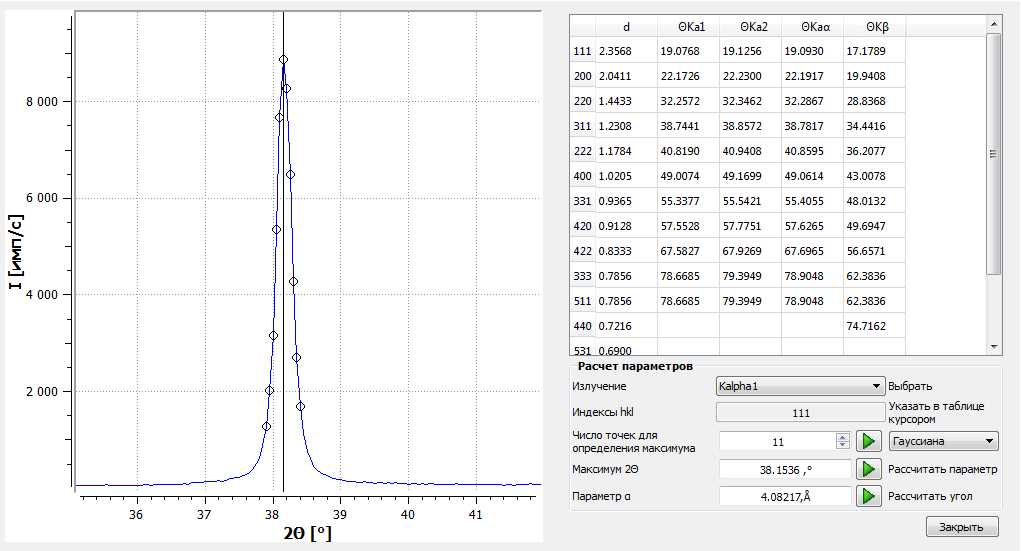
  • θ-θ scanning of the required reflex;
  • determination of the angular 2θ position of the reflex from the conducted scan;
  • calculation of the crystal lattice metric of a cubic crystal in the required direction from the determined position of the maximum.
Software for X-ray phase analysis with built-in set of powder standards

The software is designed for qualitative and semi-quantitative phase analysis of experimental X-ray diffraction patterns by search-match procedure using the built-in set of powder standards

It provides:

  • Creation of user subbases for convenient search;

  • Adding of user standards to subbases;

  • Qualitative phase analysis using various criteria and sub-bases;

  • Analysis of matched lines by their position and intensity;

  • Selection and fixing the best solutions;

  • Calculation of component concentrations by Reference Intensity Ratio;

  • Access to the set, including search by selected criteria;

  • Analysis and comparison of the results for several diffraction patterns;

  • Creation of a template for the rapid analysis of similar diffraction patterns.


Software for texture analysis

The software includes:


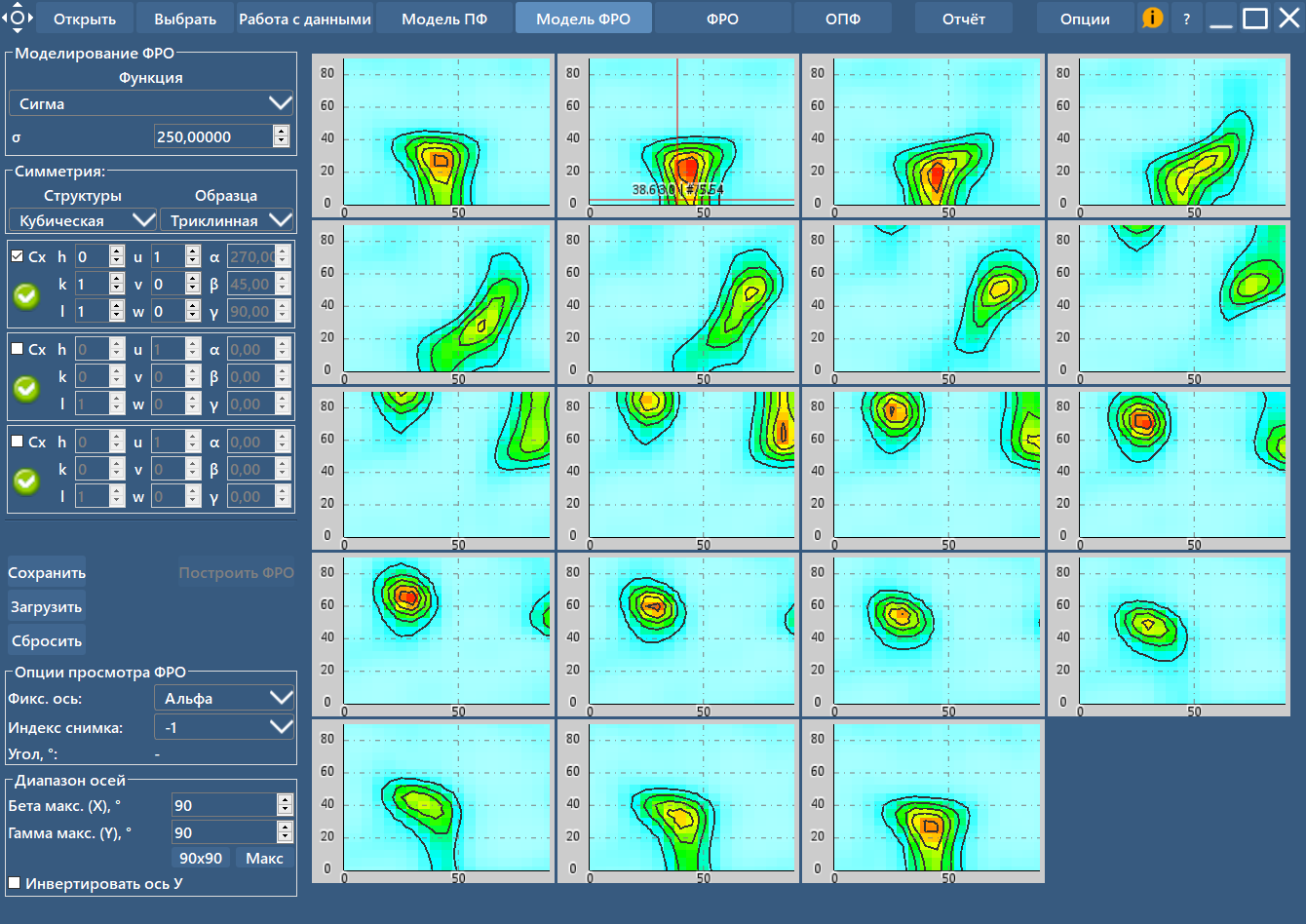
  • Building of direct pole figures from experimental data;

  • Rotation of direct pole figures by symmetry;

  • Modeling of direct pole figures;

  • Analysis of direct pole figures and orientation identification;

  • Calculation of orientation distribution function (ODF) by ADC method;

  • Restoration of complete pole figures from calculated ODF;

  • Modeling of orientation distribution function;

  • Calculation of inverse pole figures;

  • Calculation of texture index and degree of texture.


The software functionalities for the building, modeling and analysis of direct and inverse pole figures, as well as for the calculation of the orientation distribution function by the ADC method and the restoration of the pole figures are illustrated. The results of a comparative study of the complete pole figures built from experimental diffraction data and calculated from the orientation distribution function, which has been computed from a series of incomplete irregular pole figures, are presented.

«Size&Strain – Calculation of average size of coherent domains and of microstrains» Software


  • Plotting of moments dependence vs diffraction angle;

  • Calculation of size of coherent domains and microstrains by the method of second central moments;

  • Calculation of instrumental line broadening;

  • Application of absorption correction to the samples with another composition.


«DrWin – Data processing» Software

  • Processing of diffraction pattern or selected area;

  • Background approximation (by polynomial or user curve);

  • Separation of Kα-doublets;

  • Determination of angular positions;

  • Approximation of reflection profiles by pseudo-Voigt function (for the entire array or independently for each peak);

  • Calculation of peak heights and their integral intensities;

  • Calculation of FWHM of reflections;

  • Evaluation of degree of crystallinity (content of amorphous phase)
«High temperature-X-ray diffraction» Software Suite
This software provides:
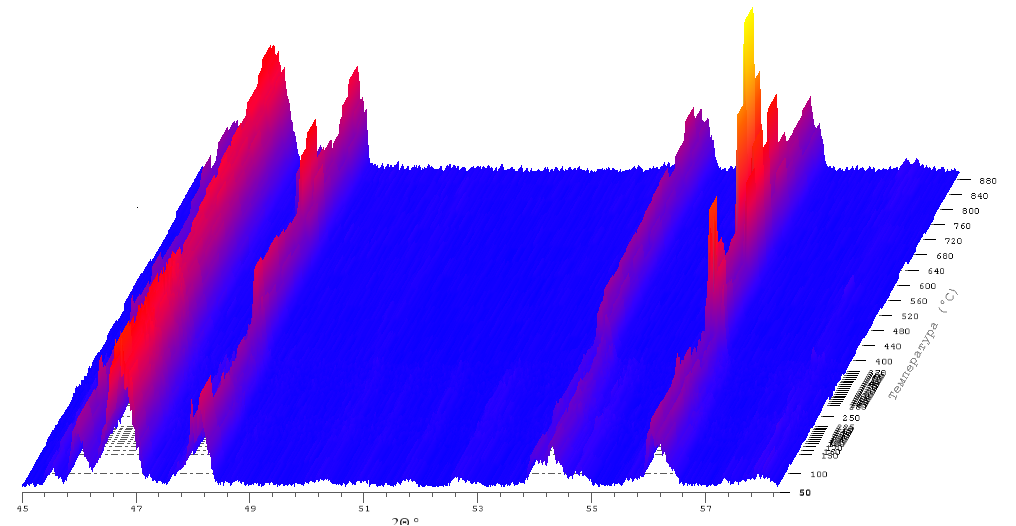
  • 3D visualization of measured X-ray diffraction data in the coordinates “diffraction angle - intensity - temperature”;
  • calibration of the entire experimental data set according to internal and external standard;
  • refinement of unit cell parameters over the entire calibrated data set;
  • determination of phase transition points;
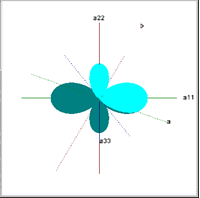
  • determination of thermal expansion coefficients in different directions and thermal strain tensors;


It is supplied together with chambers for studies under special conditions.
«Ind – Auto indexing» Software

  • Determination of Bravais lattice type;

  • Selection of unit cell;

  • Computation of Miller indices for selected lines;

  • Bar graph of input diffraction pattern.
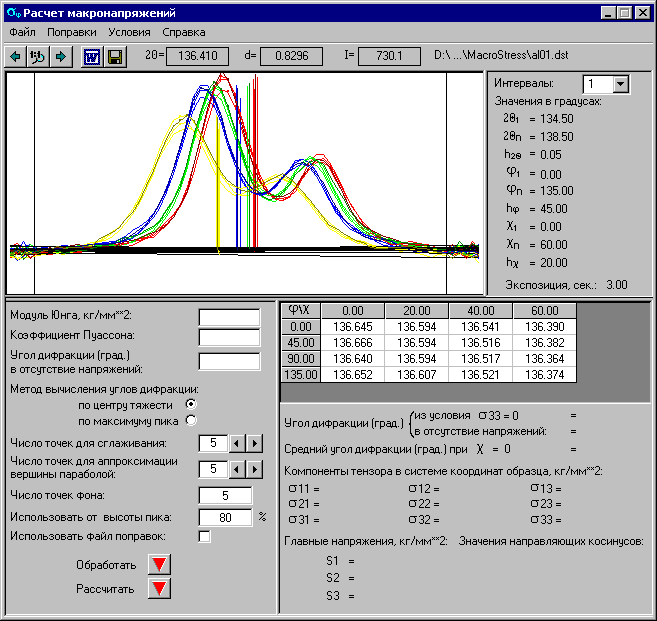
«MacroStress – Residual stress analysis» Software

  • Calculation of peak angular position from center of gravity or from peak apex;

  • Calculation of correction matrix;

  • Calculation of linear, planar and volumetric stresses;

  • Calculation of stress deviations.
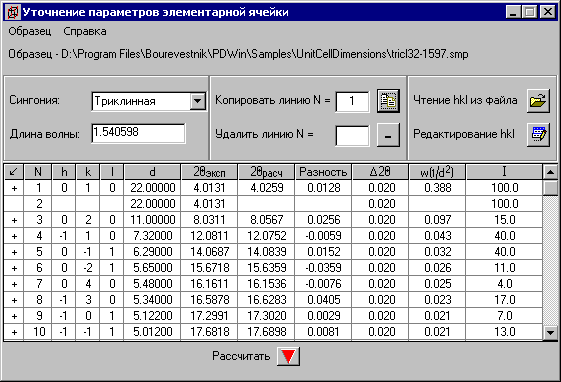
«Param – Refinement of unit cell parameters» Software
  • Calculation of unit cell parameters for any of the six crystal systems with known reflection indexes;
  • Selection of peaks for calculation;
  • Calculation of unit cell parameters for different components in multi-component systems.
«Rietveld – Rietveld method» Software

  • Loading of CIF files from ICSD and COD structural databases with their editing by user;

  • Refinement of crystal structures from X-ray powder diffraction data of single crystalline phases and mixtures;

  • Quantificaion of mixture with simultaneous refinement of selected structural parameters;

  • Calculation of polynomial and physical background;

  • Independent refinement of U, V, W, X, Y profile for different phases and for different groups of reflections;

  • Refinement of unit cell parameters, atomic and thermal parameters, occupations of atomic positions for each phase;

  • Accounting for preferred orientation of crystallites individually for selected components;

  • Selection of refinement strategy;

  • Control of refinement conditions;

  • Creation of templates for structure refinement or quantification of mixture;

  • Calculation of five R-factors.

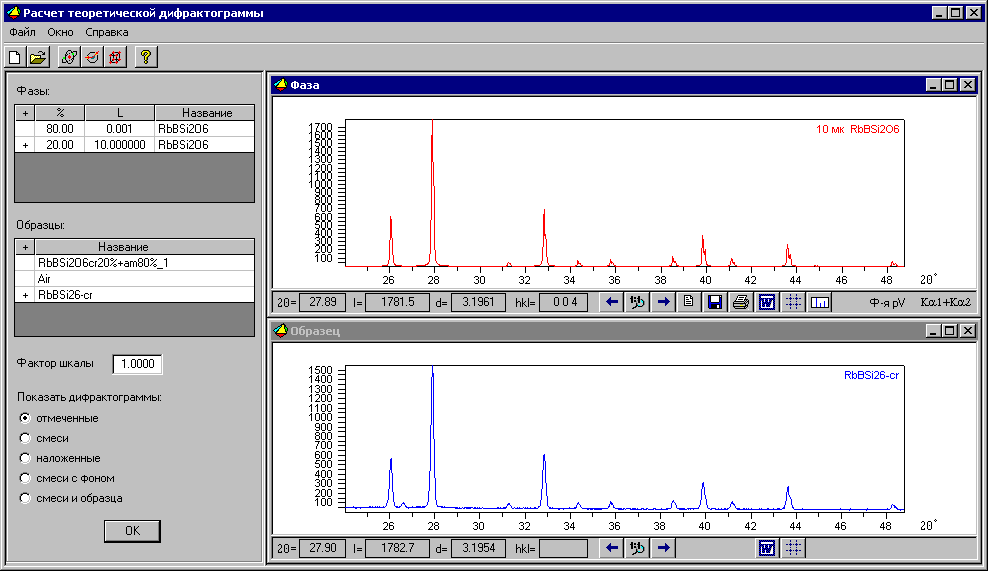
«TheorPattern - Calculation of theoretical diffraction pattern» Software

  • Loading of CIF files from ICSD and COD structural databases with their editing by user;
  • Simulation of diffraction patterns of multicomponent mixtures from structural data;

  • Account for instrumental factor;

  • Account for texture and crystalline size for each component;

  • Comparison of simulated and measured diffraction patterns;

  • Integrated package of geometrical crystallography.

«XRR simulation – Simulation of reflectivity curves » Software
-      Calculation of XRR curve from the structural model; 

-      Built-in material base; 

-      Creation of multilayer model with different parameters of layers; 

-      Calculation of layer thickness directly from FFT;

-      Refinement of main parameters of layers and substrate (thickness, density, roughness); 

-      Autofitting of XRR curve with two different algorithms;

Comparison of measured and calculated curve by χ2 criteria.
Qualitative and quantitative phase analysis by COD basis
  • search and selection of structural data according to the set criteria;
  • downloading of structural data files in *.cif format with possibility to view and edit parameters used in calculation;
  • calculation of powder X-ray radiogram according to the downloaded data in the specified angular range and for the specified wavelength, including duplets and singletons;
  • calculation of X-ray diagrams of mixtures with specified concentrations of components and with specified crystallite size for each component, as well as taking into account the preferential orientation of particles in a given crystallographic direction;
  • built-in database of calculated X-ray diagrams of standards (more than 20 thousand);
  • organization of user subbases of calculated X-ray diagrams, both from standards of the main database and directly from the COD database;
  • selection of standards from the built-in database for a specified set of chemical elements;
  • graphical visualization of measured data, comparison of experimental and calculated spectra;
  • function of intensity scaling and background subtraction for experimental data in comparison with the calculated X-ray diagram; 
  • qualitative phase analysis of samples;
  • setting the required search criteria (limitation by elemental or mineral composition, limitation by angular position error and/or by the number of coincident lines, auto-selection of the best solution, fixing of found solutions with the possibility of their exclusion from further search in case of a large number of mixture components);
  • quantitative phase analysis, including the presence of texture in one or more components;
  • refinement of unit cell parameters and texture coefficients individually for each component in the analyzed mixture (if necessary) to obtain the best result;
  • setting the range of refinement of unit cell parameters;
  • one-button report generation;
  • bilingual interface, built-in bilingual help system and tooltips.

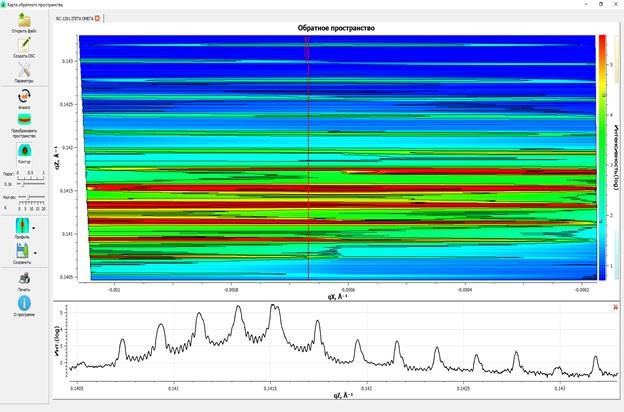
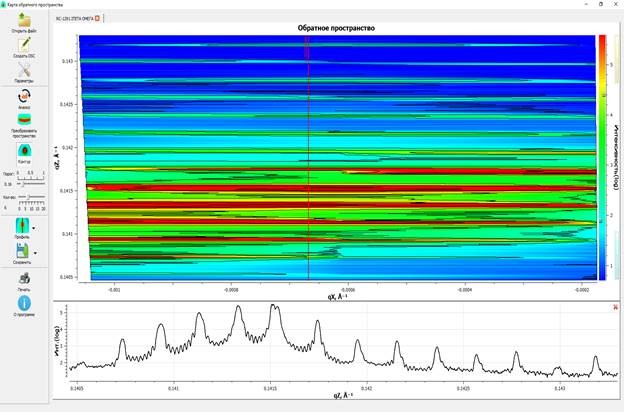
Reverse space maps - RSM

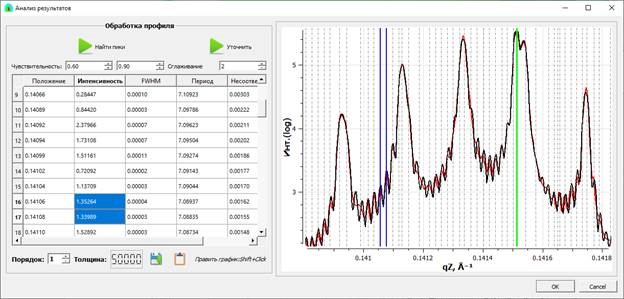
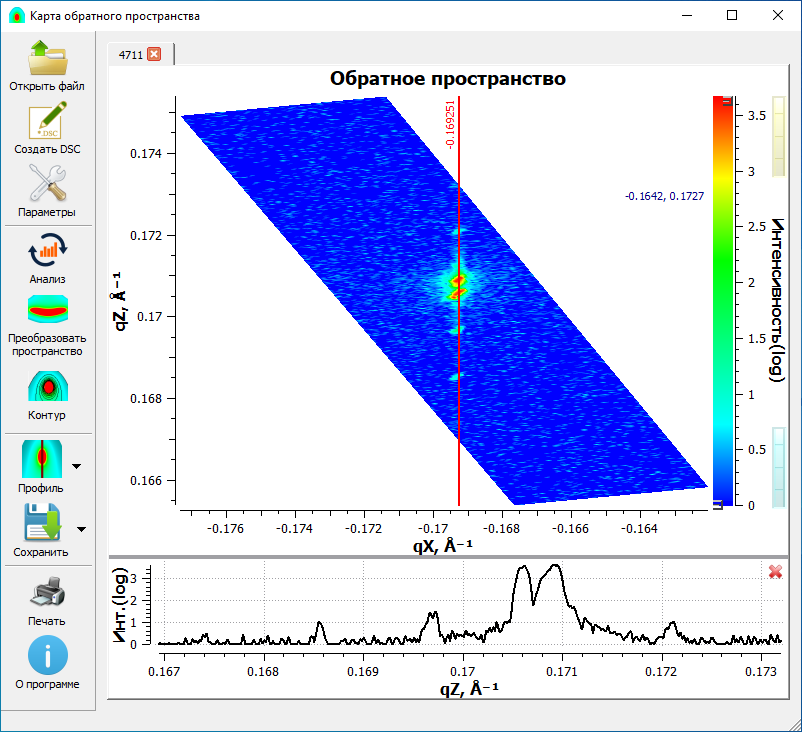
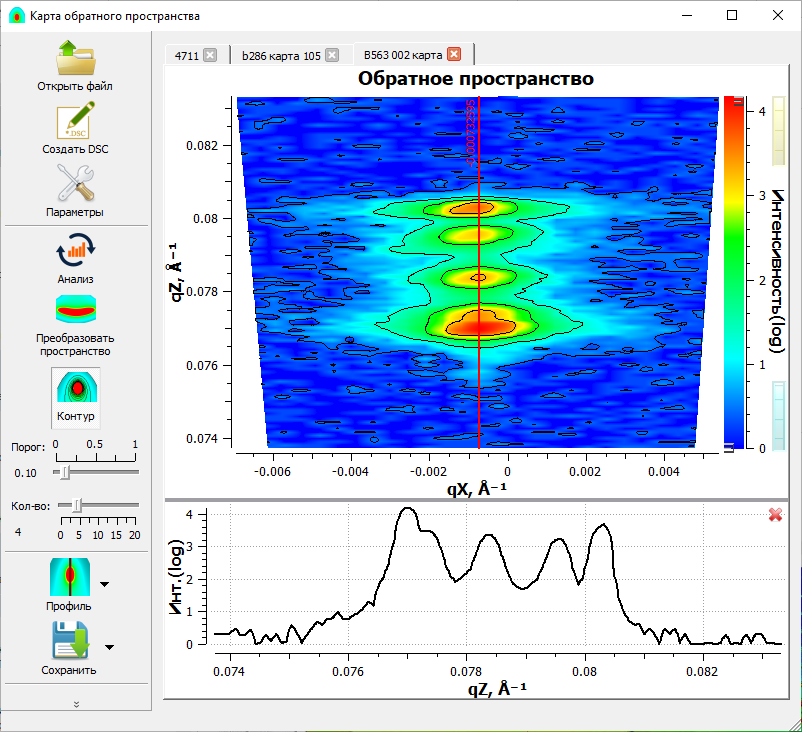
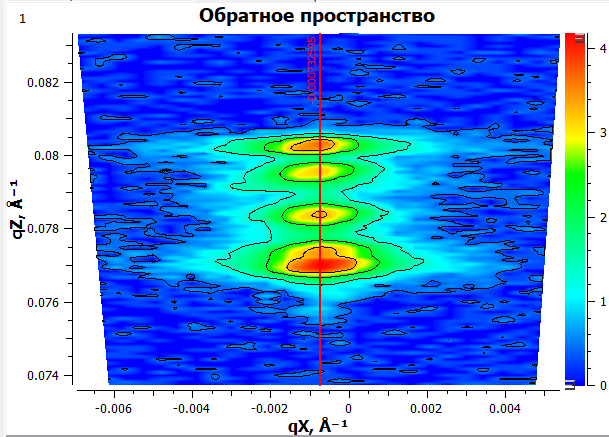
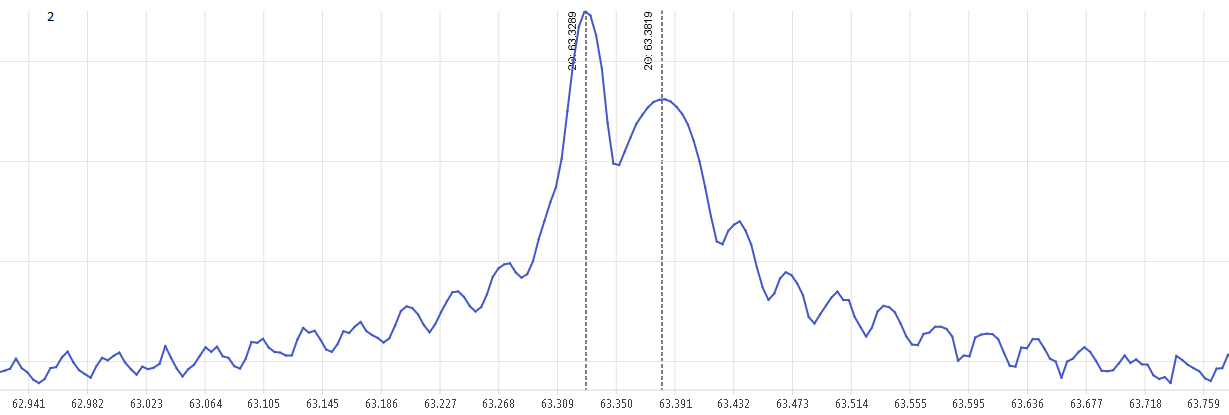
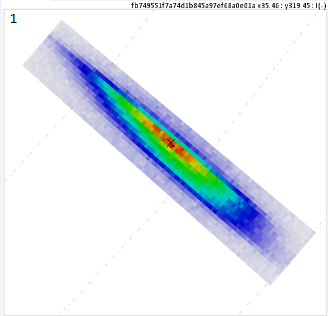
The program is designed for the construction of backspace maps using data from the diffractometer DRON-8T measured by the 2θ-Ω method in high-resolution geometry, construction of profiles in different directions, and their analysis.

Field of application: X-ray structure analysis of thin films.


The program implements:
  • conversion of experimental data in 2θ-Ω coordinates into inverse space maps in qX-qZ coordinates and vice versa;
  • construction of the map profile in the user-specified direction (vertical, horizontal, arbitrary and from point (000));
  • changing the settings of the graphical representation of the map (scaling, color scale, contrast, provision in isolines);
  • automatic search for peaks, determination of their position and intensity; smoothing and approximation of peak profiles by pseudo-Voit function;
  • calculation of structure parameters of the investigated objects and analysis of its defects by two-dimensional intensity distribution (calculation of lattice parameters by the position of Bragg maxima, calculation of substrate and layer mismatch, calculation of layer thickness by oscillations);
  • automatic generation of 2θ-Ω intervals by specified qX-qZ values and estimation of experiment time;
  • saving of processing results - map and profile - in *. png and *.txt formats and print them out.
Software option “XY-mapping”

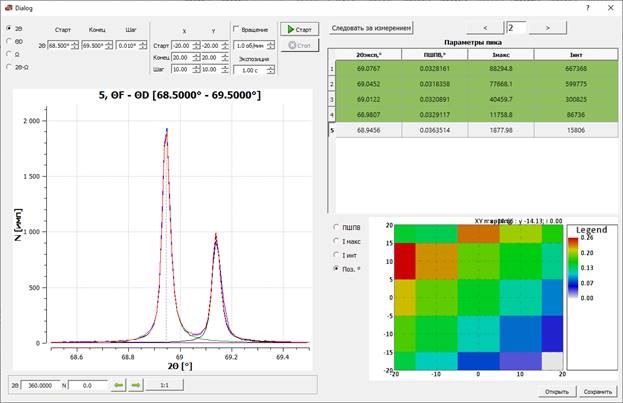
Software option “XY-mapping” for local analysis of phase composition and structural characteristics of monolithic objects at different points of their surface with automatic output of the investigated area under the X-ray beam.

It is realized on attachments with motorized carriages for moving the sample under the X-ray beam independently in two perpendicular directions.

Depending on the object and task, the scanning method (2θ, θ, Ω, 2θ-Ω) and the analyzed characteristic of the measured reflex (SNR, intensity integral or maximum, angular position) are selected.

X-ray optical patterns

Bragg-Brentano parafocusing (basic)
Additional
Analysis of residual stresses and of single crystal orientation
Debye-Sherrer
Grazing incidence geometry
High resolution geometry
Parallel-beam geometry
Reflectometry
Small-angle X-ray scattering

Objects of research

Monocrystals and products made of them
Thin films, epitaxial nanoheterostructures
Dispersed materials and powders (natural and synthetic)
Monolithic polycrystalline samples (ceramics, parts, structures, rocks, etc.)
Examples
Analysis of epitaxial films
Determination of orientation of single crystals
Quality analysis of single crystals
Monocrystals and products made of them

  • determining orientation and quality;

  • analyzing lattice metrics.


Thin films, epitaxial nanoheterostructures

  • composition, thickness and roughness analysis;

  • layer mismatch analysis;

  • lattice metric analysis.

Dispersed materials and powders (natural and synthetic)

  • qualitative and quantitative phase analysis;

  • calculation of lattice metrics;

  • calculation of crystallite sizes and microstrains;

  • texture analysis;

  • analysis of phase transformations, chemical reactions and thermal lattice deformations.


Monolithic polycrystalline samples (ceramics, parts, structures, rocks, etc.)

  • residual stress analysis;

  • texture analysis;

  • phase analysis of materials;

  • structural characterization analysis;

  • surface mapping.

Analysis of epitaxial films
  1. Reverse space map.
  2. mismatch and layer parameters, 2Ѳ-Ω scans.
Determination of orientation of single crystals
  1. by Ω-φ or χ-φ scan;
  2. by φ-scan.

Quality analysis of single crystals

  1. by Ω-φ or χ-φ scan;

  2. by rocking curves (Ω-scan).

Video materials